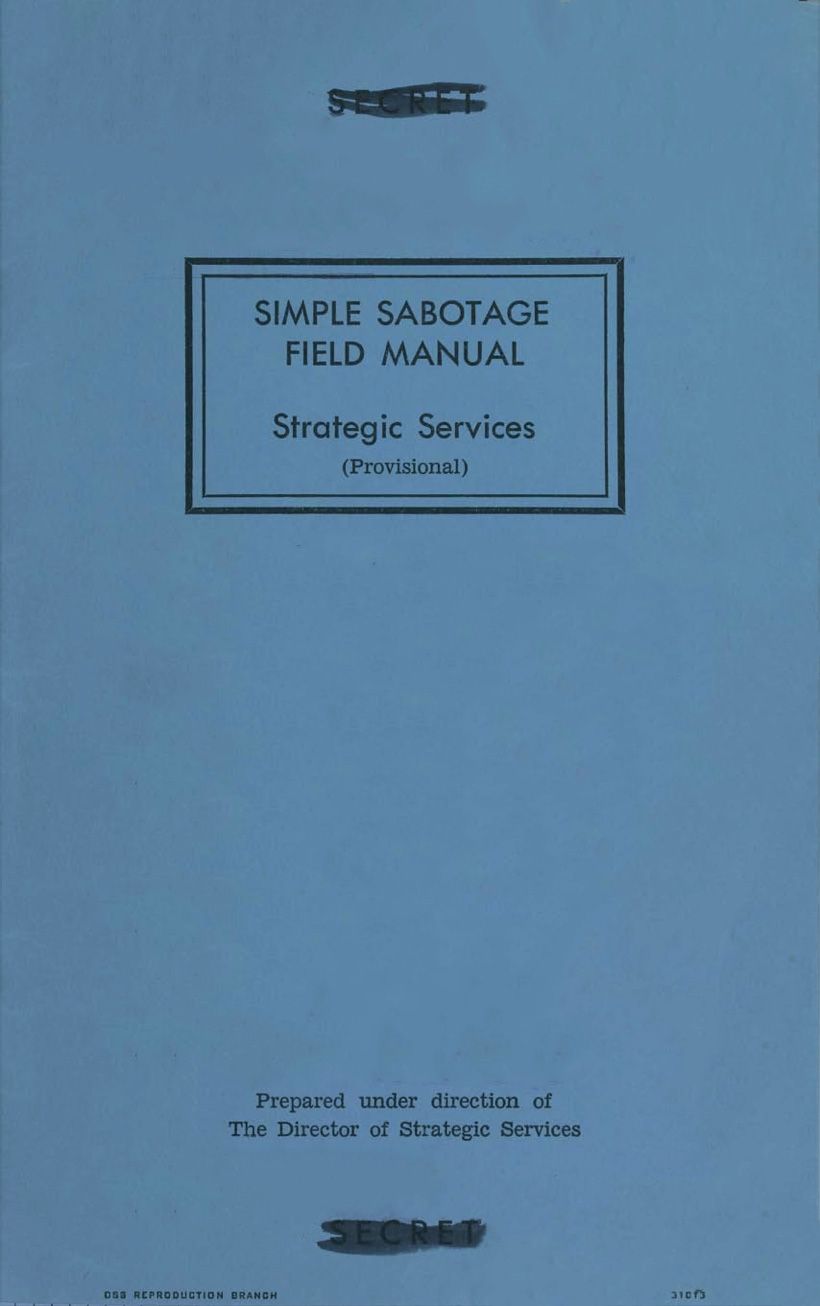





The manual presents a doctrine for inciting and executing simple sabotage by ordinary citizens who lack specialized equipment or training. It operates on the premise that widespread, unorganized disruption can create a cumulative drag on an adversary's resources, infrastructure, and morale. The author distinguishes between destructive acts involving common household items and indirect obstruction rooted in the human element of decision-making and workplace behavior.
For the individual saboteur, the text addresses the challenge of motivation in the absence of immediate personal gain. It proposes anchoring expectations to tangible local outcomes, such as the removal of specific restrictions, while fostering a sense of participation in a broader, unseen movement. Safety measures emphasize selecting targets and methods that minimize the risk of detection, leveraging plausible deniability, and exploiting the cover of everyday routines.
The document categorizes specific suggestions across various sectors, beginning with general industrial production. Workers are instructed on how to induce wear and tear on cutting tools, introduce gritty contaminants into lubrication systems, and clog cooling systems with foreign particles. Similar methods of subtle degradation are applied to electrical motors, transformers, and heavy machinery, aiming to cause overheating, short circuits, and mechanical failure without attracting immediate suspicion.
Transportation networks, including railways and automotive transit, form a major sector for disruption. Saboteurs are advised to misroute freight, tamper with track switches, damage signaling equipment, and introduce impurities into fuel and oil supplies. In office environments and administrative hierarchies, the manual outlines methods of bureaucratic sabotage. These include insisting on rigid adherence to channels, referring matters to excessively large committees, multiplying paperwork, and practicing calculated misunderstanding of orders to bring institutional progress to a halt.
The text concludes with general devices for lowering morale and generating confusion through social friction and feigned stupidity. By weaponizing ordinary tasks, administrative bureaucracy, and human communication channels, the manual establishes a framework where everyday actions become tools of systemic obstruction. The strategic objective remains the steady erosion of efficiency through decentralized, low-risk acts executed by individuals within their normal occupations.