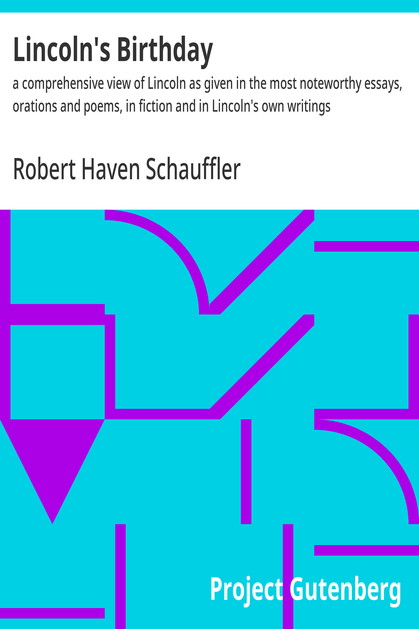



This comprehensive anthology opens with an account of the vast body of literature dedicated to Abraham Lincoln, noting the enduring need to unify scattered material into a single volume. Robert Haven Schauffler presents noteworthy essays, orations, poetry, characteristic anecdotes, and Lincoln's most famous writings, including his own brief autobiography written in eighteen fifty-nine. The text details his birth in a Kentucky log cabin, his early struggles through manual labor and extreme poverty in Indiana and Illinois, and his self-education driven by an ardent love of knowledge.
Biographical sketches by Osborn Oldroyd and Horace Greeley illuminate Lincoln's formative years, his flatboat voyages to New Orleans, and his early attempts at various trades, from store clerk to county surveyor. Accounts of his sensitive honesty, such as walking miles to rectify a minor overcharge, establish his moral foundation. His participation in the Black Hawk War as a captain of volunteers is detailed alongside stories of his practical humanity and kindness to the unfortunate.
The narrative advances to his maturity, covering his marriage to Mary Todd in Springfield and his emergence as a prominent lawyer and politician. Hamilton Wright Mabie analyzes Lincoln's distinct literary style, tracing his self-education through the Bible, Aesop's Fables, Robinson Crusoe, and The Pilgrim's Progress. This section explores how a lonely frontier upbringing forged a master of English prose whose public addresses attained classic status through simplicity and depth of feeling.
Ida Tarbell's historical account details Lincoln's rise as a national figure, highlighting his pivotal debates with Stephen Douglas in eighteen fifty-eight. The famous house-divided speech and the Freeport doctrine are examined as turning points that forced the nation to confront the moral wrong of slavery. Despite losing the senatorial election, Lincoln secured his position as the intellectual leader of the Republican party, culminating in his nomination and election to the presidency in eighteen sixty.
The tragedy of the Civil War is viewed through contemporary writings, including James Russell Lowell's essay on Lincoln's statecraft and James A. Garfield's address on the Emancipation Proclamation. The narrative captures the immense burdens borne by the President, his unwavering devotion to preserving the Union, and his profound gentleness toward soldiers and citizens alike. The volume addresses the fierce abuse he faced and his unique ability to guide public opinion through patience and practical wisdom.
The final section chronicles the assassination of Lincoln at Ford's Theatre on April fourteenth, eighteen sixty-five, drawing on Walt Whitman's vivid descriptions. Tributes from poets, statesmen, and foreign observers, including Ralph Waldo Emerson, Henry Ward Beecher, and George Bancroft, reflect the universal grief and the immediate elevation of Lincoln to martyrdom. The collection concludes by framing his death as the sealing of the nation's new birth of freedom and the cementing of his enduring legacy in the human heart.