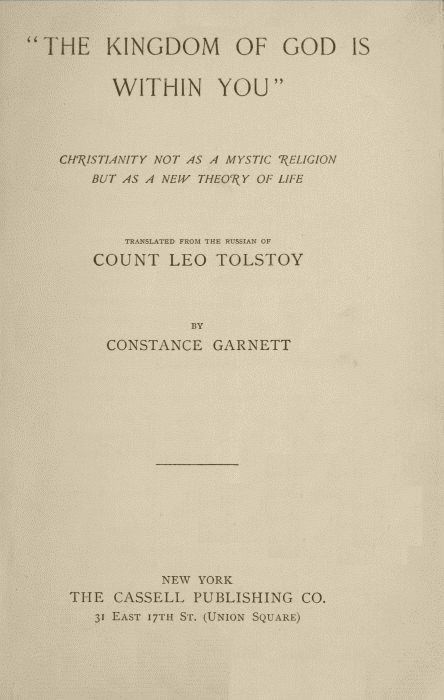





The book examines the deep contradiction between the teachings of Christ, particularly the doctrine of non-resistance to evil by force, and the reality of modern state organization, warfare, and institutional Christianity. Tolstoy argues that official churches have systematically obscured the true meaning of the Gospel by substituting rituals, dogmas, and the state-sanctioned use of violence for the radical demands of Christian love and pacifism. He highlights historical predecessors who championed non-resistance, such as the Quakers, William Lloyd Garrison, Adin Ballou, and Peter Helchitsky, showing how their work has been met with a silent conspiracy of suppression by both religious authorities and secular liberals. The text explores the pervasive moral dilemmas faced by modern individuals who profess Christian ethics while actively participating in economic oppression, legal injustice, and military conscription.
By contrasting the social conception of life with the divine conception revealed by Christ, the author demonstrates that true Christianity requires a total rejection of violence and state authority. Ultimately, the book calls on every individual to resolve the agonizing split between conscience and conformity by refusing military service and embracing the unyielding ideal of universal love and spiritual freedom, despite the societal costs and persecutions that such a stance inevitably invites. The arguments develop through a rigorous critique of contemporary hypocrisy and a call for a fundamental moral awakening across human society, pointing toward a future where the kingdom of God is realized from within rather than imposed through external coercion and state power.
The narrative unfolds with a passionate moral urgency, exposing the complicity of modern institutions in maintaining systems of violence and demanding an authentic return to the original, uncompromising spirit of the teachings of Jesus Christ in daily life and international relations alike. Through detailed examinations of theological evasions and the tragic realities of universal militarism, the work exposes the intellectual bankruptcy of those who defend war as a natural or beneficial necessity for human progress and survival. The culmination of the argument rests on the absolute necessity of individual moral responsibility, urging a complete break with corrupted societal traditions and an embrace of a peaceful existence governed solely by the divine law of love and non-violence. The text stands as a monumental challenge to the complacency of civilization, urging readers to confront the moral abyss of modern warfare and choose the path of spiritual integrity over the destructive obedience demanded by secular governments and compromised churches.
The discussion ultimately weaves together historical analysis, scriptural interpretation, and piercing social commentary to dismantle the intellectual defenses of violence and present a coherent, radical vision of a society transformed by genuine Christian love and passive resistance to evil. The unfolding argument addresses both believers and freethinkers, laying bare the deep-seated misunderstandings that prevent humanity from realizing the true promise of the Gospel and establishing an enduring peace on earth through the regeneration of individual souls. The profound moral challenge presented in the text resonates across generations, calling into question the very foundations of modern political and economic structures in light of the uncompromising moral demands of Christ's teachings on peace, brotherhood, and non-resistance to evil by force of arms.
The enduring message emphasizes that true human progress can never be achieved through bloodshed and coercion, but only through the courageous, individual pursuit of spiritual perfection and active love for all humanity, regardless of nationality, creed, or state-imposed obligations to participate in military conflicts and organized violence. The comprehensive critique reaches its climax in a stirring appeal for intellectual and moral honesty, urging every thinking person to reject the narcotic illusions of state propaganda and church complacency, and to take a personal stand against the brutal machinery of war that continues to threaten the sanity and survival of the human race. The work concludes by reiterating that the realization of the kingdom of God depends entirely upon the willingness of individuals to live out the truth of non-resistance, embracing suffering if necessary, and thereby helping to usher in a new era of universal peace, justice, and spiritual harmony among all nations and peoples of the world without exception or compromise. The profound implications of this doctrine challenge the foundational assumptions of contemporary politics, economics, and religion, offering a rigorous blueprint for a moral revolution based on love, humility, and the rejection of all forms of state-sanctioned violence.
The timeless relevance of these ideas continues to provoke deep reflection on the nature of duty, conscience, and the ultimate destiny of human civilization in an age dominated by militarism and spiritual confusion, making the text an essential cornerstone for any serious exploration of pacifism, Christian ethics, and social reform. The powerful synthesis of rigorous logic and unyielding moral conviction leaves an indelible impression on the reader, compelling a re-evaluation of personal complicity in systemic injustice and a courageous commitment to living in accordance with the highest dictates of conscience and divine truth. The overarching narrative thus serves as both a severe indictment of existing social institutions and a hopeful vision of human redemption through the steadfast practice of love, non-resistance, and moral integrity in the face of overwhelming opposition and state power.
The ultimate challenge posed by the text remains as urgent today as it was at the time of its writing, demanding that individuals awaken from their moral slumber and confront the ultimate contradiction of a world that professes peace while preparing relentlessly for war. The profound depth of Tolstoy's inquiry exposes the root causes of human suffering and social conflict, pointing the way toward a genuine liberation of the human spirit from the shackles of violence, superstition, and political oppression through the transformative power of Christian truth and love. The comprehensive vision articulated throughout the work challenges every reader to examine their own life and choices, refusing to hide behind collective responsibility or state mandates, and embracing the personal duty to stand firmly for peace, justice, and the inviolable sanctity of human life everywhere on earth. The final synthesis reinforces the absolute incompatibility of Christianity with militarism and government coercion, leaving no room for equivocation or compromise for those who genuinely seek to follow the moral teachings of Jesus Christ in a world torn apart by violence and nationalistic hatreds.
The enduring significance of this monumental work lies in its uncompromising demand for authenticity, its piercing critique of institutional hypocrisy, and its unwavering faith in the power of truth and love to transform the individual soul and redeem human society from the tragic cycle of war and oppression that has plagued humanity for centuries. The profound wisdom contained within these pages continues to inspire seekers of truth and peace across the globe, challenging them to live courageously and authentically in alignment with the eternal principles of the divine law inscribed within every human heart. The overarching message remains a beacon of hope and a stern warning to a world stumbling blindly toward catastrophe, reminding all who read it that the salvation of humanity depends entirely upon the moral courage of individuals willing to renounce violence and embrace the transformative power of universal love and non-resistance.
The ultimate legacy of the book is its unshakeable assertion that peace is not merely an idealistic dream or a diplomatic arrangement, but a strict moral imperative and the indispensable foundation of any truly human existence, demanding the total dedication of every individual heart and mind to the realization of the kingdom of God within ourselves and in the world around us. The comprehensive argument thus concludes with a resonant call to action, urging readers to cast off the hypnotic deceptions of churches and governments, and to live openly, fearlessly, and lovingly as true followers of Christ in an age of profound moral crisis and uncertainty. The enduring power of the text rests on its ability to strip away the complex rationalizations of modern civilization and expose the simple, undeniable truth that love and violence can never be reconciled, and that true human progress can only be achieved when individuals summon the moral strength to say no to war, no to oppression, and yes to the divine law of love that unites all mankind in a single universal brotherhood. The profound clarity and moral force of these conclusions make the work an immortal masterpiece of ethical philosophy and religious thought, challenging each new generation to re-examine its values and choose the difficult but life-affirming path of non-resistance, spiritual integrity, and uncompromising love for all people regardless of artificial national and political divisions.
The ultimate truth illuminated by the text is that true freedom and lasting peace are only possible when individuals break free from the hypnotic grip of state violence and religious formalism, committing their lives wholly and fearlessly to the service of God and their fellow men through the practice of active, unconditional love and radical non-resistance to evil. The timeless wisdom of these pages provides an unfailing compass for navigating the turbulent moral landscape of the modern world, offering a clear and uncompromising vision of a society redeemed by truth, justice, and peace. The final legacy of the work is an enduring testament to the power of the human conscience when awakened to the divine reality within, challenging all people of good will to abandon the brutal ways of the past and help build a future worthy of our highest spiritual aspirations and deepest moral convictions.
The profound resonance of this message continues to challenge, inspire, and guide those who seek a better way of living, proving that the principles of the Sermon on the Mount are not impractical dreams, but the essential, unalterable conditions of true human happiness and survival. The comprehensive framework established throughout the book offers a complete and coherent philosophy of life that transcends the limitations of political ideologies and religious dogmas, pointing the way toward a universal spiritual awakening rooted in love, humility, and the total rejection of violence and coercion in all human affairs. The ultimate triumph of the work lies in its unshakable conviction that the truth will ultimately prevail over falsehood, and that the kingdom of God will indeed be realized on earth when men finally open their eyes to the light of the Gospel and take up the cross of peaceful, non-resistant love with courage, devotion, and unwavering faith. The enduring power of these insights guarantees that the work will remain a vital and transformative text for anyone seeking to understand the deep contradictions of modern civilization and the path toward genuine moral and spiritual renewal.
The final message is one of profound hope combined with rigorous personal responsibility, reminding us that the choice between war and peace, between barbarism and true civilization, rests ultimately in the hands of each individual man and woman alive today. The profound unity of thought and conviction running through the entire volume leaves the reader with a deepened understanding of the true nature of Christianity and a renewed commitment to living a life of active love, peace, and moral integrity in a world desperately in need of spiritual healing and transformation. The enduring brilliance of the work shines through every page, offering an unshakeable foundation for a peaceful, just, and truly human society built on the eternal principles of divine truth and universal brotherhood.
The final synthesis of ideas presented in the text represents one of the most powerful and coherent critiques of state-sanctioned violence and institutional hypocrisy ever produced, challenging humanity to rise above its animal instincts and fulfill its divine destiny through the practice of absolute love and non-resistance. The profound intellectual and moral journey traced in the book leaves an indelible mark on all who engage with its arguments, compelling a radical re-examination of personal values and a courageous dedication to the cause of universal peace and human brotherhood. The ultimate significance of the work transcends its historical context, speaking directly to the profound moral and existential crises of our own time with undiminished relevance, clarity, and force. The comprehensive vision articulated in the text remains a supreme monument to the power of human reason and conscience when illuminated by the highest spiritual ideals, pointing the way toward a future where peace, justice, and love reign supreme in the hearts of all men and nations without exception or compromise. The final legacy of this remarkable book is an enduring challenge to the conscience of humanity, calling us away from the destructive paths of violence and hatred toward the radiant light of truth, freedom, and universal love that defines the true kingdom of God within us all.