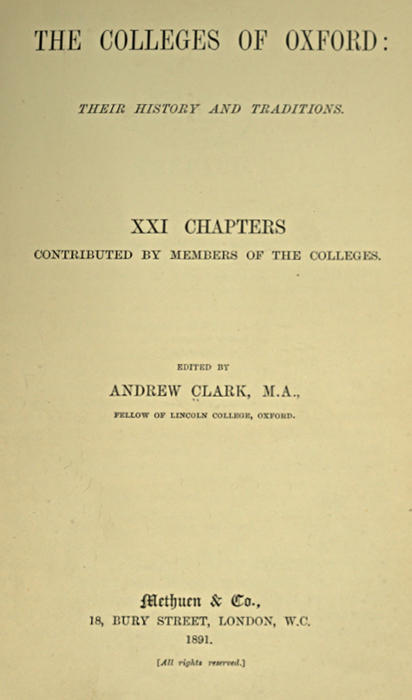




This work presents an extensive historical and architectural study of several foundational colleges within the University of Oxford, detailing their origins, domestic lives, and structural developments across the centuries. The narrative begins with Balliol College, tracing its early benefactions, its precious fifteenth-century library, and its periods of decline and recovery, particularly through its enduring connection with Scottish exhibitions and figures such as Adam Smith. The account then transitions to Merton College, recognized as the archetype of the collegiate system, established by Walter de Merton in the thirteenth century to combine academic study with secular clergy training. The text outlines Merton's architectural legacy, its internal discipline enforced through statutes and visitations, and its resilience through civil wars.
The volume proceeds to examine Exeter College, founded by Bishop Walter de Stapeldon in the early fourteenth century to prepare students for service in Church and State, highlighting its architectural expansions and its experiences through the religious and political upheavals of the Reformation and Civil War. Following Exeter, Oriel College is explored through the initiatives of Adam de Brome and King Edward the Second, detailing its acquisition of La Oriole and the evolution of its governing statutes. The account details Oriel's internal disputes, its financial struggles during the seventeenth century, and its eventual rise to prominence in the late eighteenth and early nineteenth centuries under the leadership of figures like Provost Copleston.
The history of Queen's College is traced from its foundation by Robert of Eglesfield, chaplain to Queen Philippa, focusing on its north-country preferences, its common table traditions, and its rebuilding phases driven by dedicated provosts. The narrative then turns to New College, founded by William of Wykeham to rival monastic grandeur and to establish an intimate connection with a grammar school in Winchester. New College is examined for its harmonious architectural design, its strict disciplinary codes, and its long tradition of scholarly conservatism before modern academic reforms.
The final section of the text details Lincoln College, established by Bishop Richard Fleming to defend traditional Church doctrines against early reforming movements. Lincoln's development is charted through the restorative efforts of Bishop Rotheram, the acquisition of its library and endowments, and the daily administration of its academic and spiritual duties. Throughout the work, the author synthesizes archival records, treasurer accounts, and visitor injunctions to reconstruct the institutional identity of these foundational academic societies.