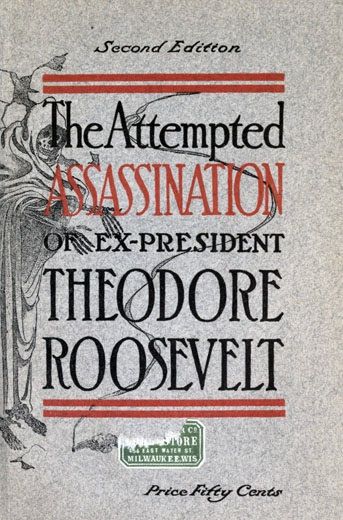




On the night of October fourteen, nineteen hundred and twelve, a deranged man named John Flammang Schrank shot former President Theodore Roosevelt outside a Milwaukee hotel. The bullet, slowed by a thick manuscript and a metal spectacle case lodged in the chest wall near the fourth rib, failed to kill the statesman. Despite severe pain and profuse bleeding, Roosevelt insisted on proceeding to the convention hall, where he delivered an eighty-minute address to nine thousand people, declaring that it took more than one bullet to kill a bull moose.
The narrative follows the immediate aftermath, including Roosevelt's medical examination at the Johnston Emergency Hospital and his subsequent transfer by special train to Mercy Hospital in Chicago, where he was joined by his family. Throughout his recovery, Roosevelt maintained his characteristic resilience, quickly returning to political commentary and urging his supporters and opponents to continue the campaign without letting the violent act alter the democratic debate. Meanwhile, local authorities placed Schrank under arrest, subjecting him to intense interrogations where he revealed elaborate delusions centered on the sanctity of the third-term tradition and a spectral visitation from the spirit of the assassinated President William McKinley.
Milwaukee Municipal Judge August C. Backus instituted a novel legal procedure, bypassing the typical battle of paid medical experts by appointing an independent commission of five alienists to examine the prisoner. The medical reports established that Schrank suffered from systematized grandiose delusions and severe paranoia. The detailed commission findings confirmed that the assassin acted entirely on his own warped convictions, believing himself to be an instrument of divine will tasked with defending the unwritten laws of the republic against political ambition.
The legal proceedings culminated on November twenty-two, when the court formally declared Schrank insane and ordered his commitment to the Northern Hospital for the Insane at Oshkosh. The documentation preserves Schrank's own written defense and extensive statements, offering a rare psychological window into the mind of a political fanatic. The volume concludes by highlighting the groundbreaking judicial precedent set by Judge Backus in handling expert medical testimony in cases involving mental incompetence.