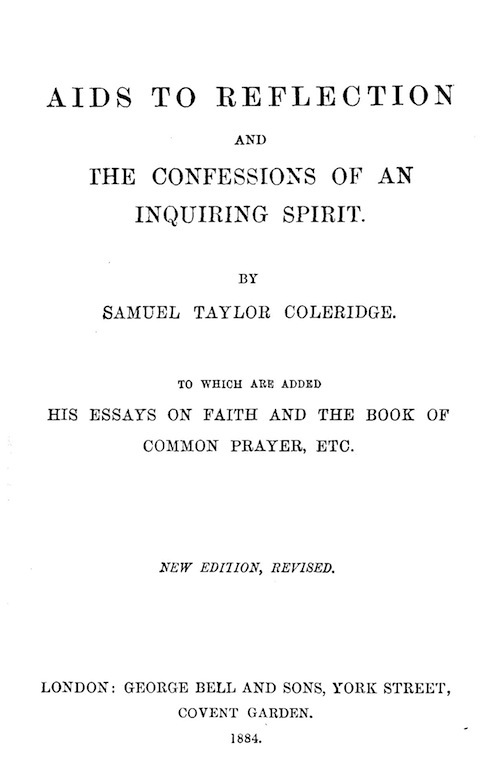



The work opens with an introspective account of the author's early literary life, detailing his education under a rigorous master who taught that poetry possesses a logic as severe as science. Coleridge reflects on the reception of his juvenile poetry and the profound influence of contemporary sonnets, which helped him transition from abstract metaphysical speculation toward a more natural style of writing. He explores the distinction between the poetry of the eighteenth century, characterized by witty observation and epigrammatic couplets, and the newer poetry of nature.
Addressing the charge of the irritability of men of genius, the author argues through historical examples that true genius is inherently calm and tranquil. He traces the source of this false charge to vain aspirants who mistake the desire for genius for its actual power, as well as to the rise of anonymous reviewing driven by malevolence and bad passions. He defends his friend Robert Southey against persistent attacks, highlighting Southey's immense erudition, moral integrity, and unmatched industry across poetry and prose.
The inquiry shifts toward the Lyrical Ballads and the critical controversy surrounding William Wordsworth's poetry. Coleridge asserts that the hostility directed at these works arose not from the poems themselves, but from the theoretical prefaces that accompanied them. He analyzes the evolution of Wordsworth's poetic genius and introduces a crucial distinction between two faculties long confused: fancy and imagination. While fancy is merely a mode of memory emancipated from the order of time and space, imagination is a shaping and modifying power that unites the perception of an external object with the internal life of the mind.
To establish a secure foundation for this aesthetic theory, the author delves deep into psychology and the history of philosophy, tracing the law of association from Aristotle through Descartes and Hobbes to Hartley. He demonstrates the fundamental flaws of materialist associationism, arguing that the mind is not a passive machine driven by external mechanical impacts, but an active, self-conscious will. Through an extensive metaphysical exploration, he builds toward a transcendental philosophy that reconciles the objective world of nature with the subjective intelligence of the spirit, showing that authentic knowledge rests upon the original identity of being and knowing.