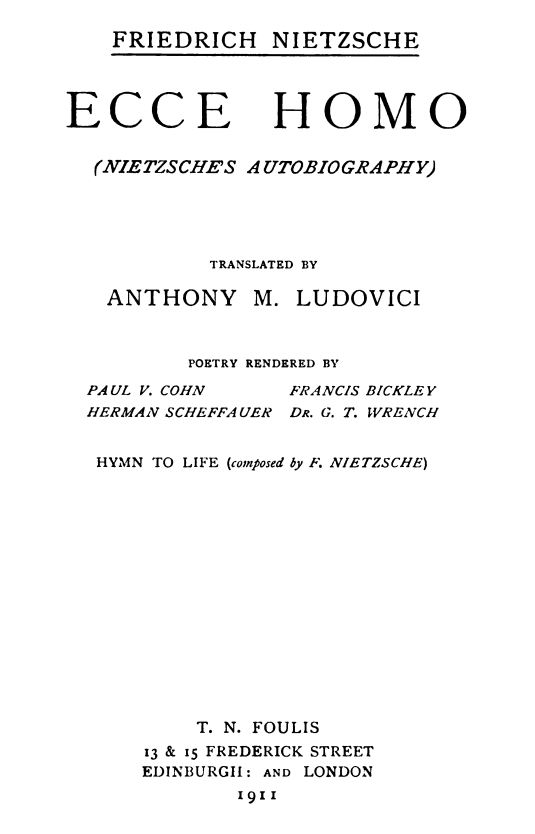



Friedrich Nietzsche writes Ecce Homo in the autumn of eighteen eighty-eight as a grand summing up of his character, his purpose as a reformer, and his achievement as a thinker. He seeks to dispose of all discussion and doubt concerning his personality, leaving the public mind free to consider the things for the sake of which he existed. The book serves as a deliberate preparation for his ultimate demand upon mankind: the transvaluation of all values.
The author begins with a cold and calculating self-analysis, examining the physiological conditions of his existence, his periods of profound physical weakness, and his recovery through an instinctive will to health. He explains how his double origin, combining both ascending and descending life, granted him a unique neutrality and a sensitive mastership over questions of decadence. Rather than viewing his long illnesses as a curse, he treats them as a vital stimulus that shaped his philosophy and purged him of pessimism.
Nietzsche then turns his critical focus toward the history of philosophy, morality, and religion, targeting the core tenets of Christianity, idealism, and romanticism. He asserts that the true world of ideals has been falsely assumed to rob reality of its value, making human instincts mendacious and false. By unmasking morality as an idiosyncrasy of decadents and an expression of the will to nonentity, he lays the groundwork for an entirely new, life-affirming outlook that embraces the terrors and questions of existence.
Throughout the work, he reviews his previous major writings, including The Birth of Tragedy, Thus Spake Zarathustra, and Beyond Good and Evil, elucidating the logic and consequences of his core ideas. He presents Zarathustra as his greatest gift to humanity, a profound and inexhaustible well of truth born of an infinite treasure of light and joy. The text culminates in his bold assertion of his destiny as a force majeure, a fatal crisis for all traditional beliefs, and the first immoralist who dares to say a complete and unreserved yes to life.