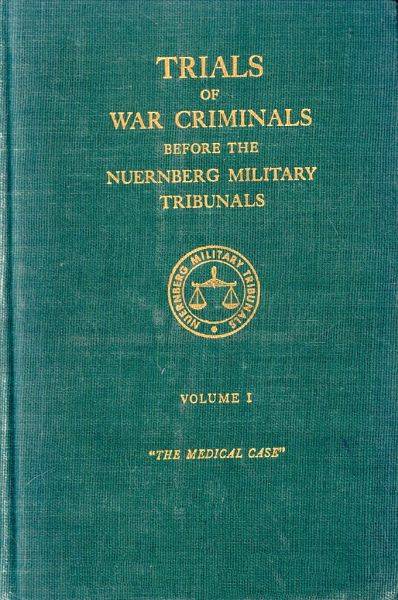


The historical collection opens with the foundational agreements and laws that authorized the prosecution of major war criminals following the Second World War. These include the Moscow Declaration, the London Agreement, the Charter of the International Military Tribunal, and Control Council Law Number Ten, which established a uniform legal basis for military tribunals within occupied Germany. The volume details the organizational structure of these courts, outlining the powers of the military governor, the rules of procedure, and the rights of defendants to ensure a fair trial.
A central portion of the text is dedicated to Case Number One, officially designated as the United States of America versus Karl Brandt and others, commonly known as the Medical Case. The extensive opening statements and indictments detail the charges against prominent physicians, administrators, and military medical officers who participated in a common design to commit war crimes and crimes against humanity. These charges encompass systematic medical experimentation performed on concentration camp inmates without consent, involving extreme conditions such as high altitude, freezing, malaria, mustard gas, sulfanilamide, and epidemic jaundice.
Furthermore, the documentation addresses the broader apparatus of the Third Reich's medical system, illustrating how professional organizations and academic institutions were subordinated to Nazi racial policy. The text covers the implementation of the clandestine euthanasia program, which targeted the aged, insane, and incurably ill, as well as the forced sterilization projects designed to execute mass population control. The arguments presented by the prosecution establish how these atrocities were not isolated acts of sadistic individuals, but rather the logical outcome of a state-sponsored campaign of genocide and human destruction.
The volume concludes with the structural orders constituting Military Tribunal Number One, listing the presiding judges, prosecution counsel, and defense attorneys involved in the medical case. It outlines the preliminary arraignments, the formal pleas of not guilty entered by the defendants, and the initial procedural rulings governing the submission of evidence. Through these official records, the text preserves the meticulous administrative and legal steps taken to establish individual criminal responsibility for state-sanctioned abuses.