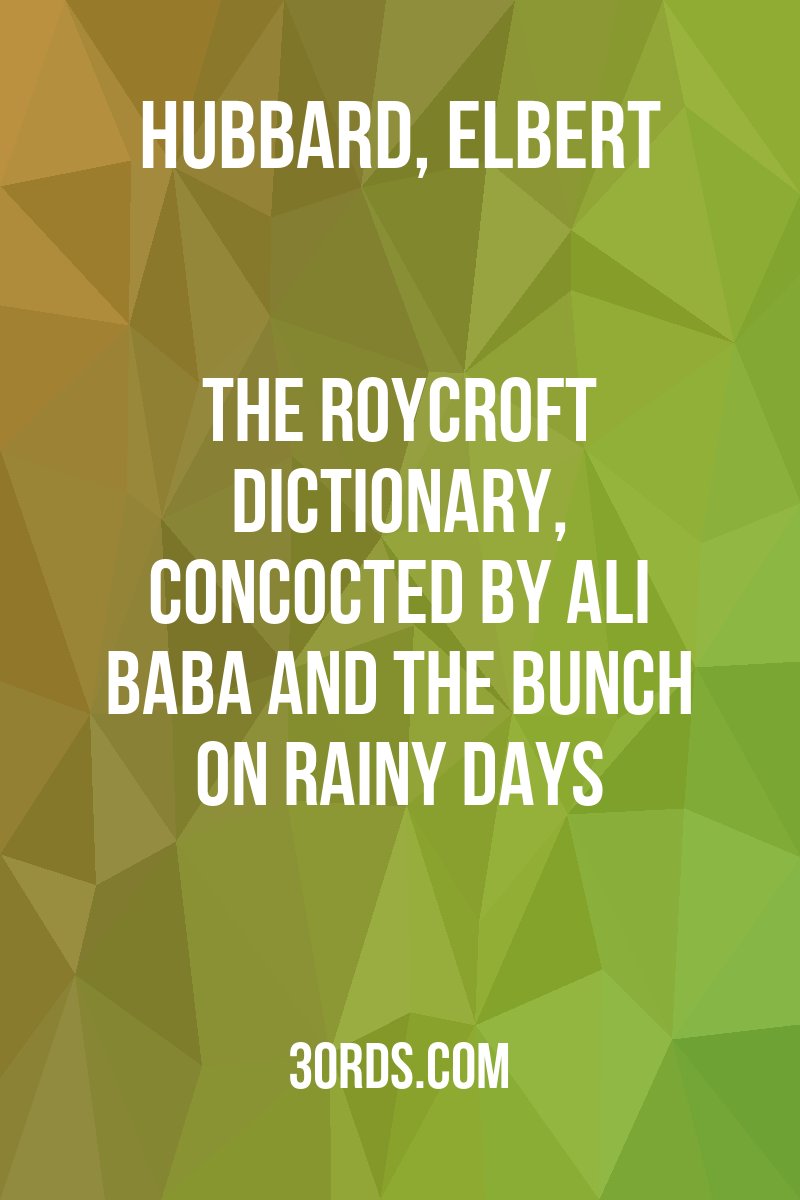



Elbert Hubbard approaches the English language not as a neutral tool of communication, but as a vast repository of human self-deception and social hypocrisy. Through a satirical dictionary format, the author targets organized religion, politics, marriage, education, and professional life, offering definitions that invert conventional wisdom and reveal the self-serving mechanisms behind accepted virtues. The central problem Hubbard addresses is the gap between how society labels its motives and why people actually act. Institutions like churches, universities, and governments are systematically unmasked as apparatuses designed to maintain power, generate profit, or enforce conformity under the guise of morality and progress.
The argument develops through an alphabetical sequence of sharp, aphoristic entries where abstract ideals are traced back to physical urges, economic interests, or ego defense mechanisms. Concepts like art, success, love, and democracy are stripped of their romantic veneer and redefined through the lens of human vanity and pragmatism. For Hubbard, a lawyer is an architect of legal plunder, a diplomat is someone who says perhaps when meaning no, and a university is an institution dedicated to the prevention of learning. Rather than building a singular linear thesis, the author deploys a cumulative barrage of irony, suggesting that civilization is merely an elaborate device for increasing human ills while celebrating mediocrity.
Throughout the text, recurring themes emerge regarding the nature of work, genuine accomplishment versus social posturing, and the inevitability of human error. Hubbard draws a hard line between mastership—defined by industry, concentration, and self-reliance—and the parasitic structures that live off productive effort. The individual is constantly pitted against the dead weight of tradition, organized cant, and public opinion. Marriage, friendship, and morality are examined not as static moral achievements, but as ongoing negotiations between personal desire and social constraint, often fraught with boredom and mutual surveillance.
The work culminates in a cynical yet strangely liberating view of existence where illusions are systematically dismantled to clear the ground for honesty and self-awareness. By treating sacred cows with utter irreverence, Hubbard suggests that true understanding begins only when one stops flattering oneself and the institutions of the age. The final impression left by the dictionary is one of bracing disillusionment, urging the listener to discard borrowed dogmas and confront the raw, unvarnished mechanics of human nature.