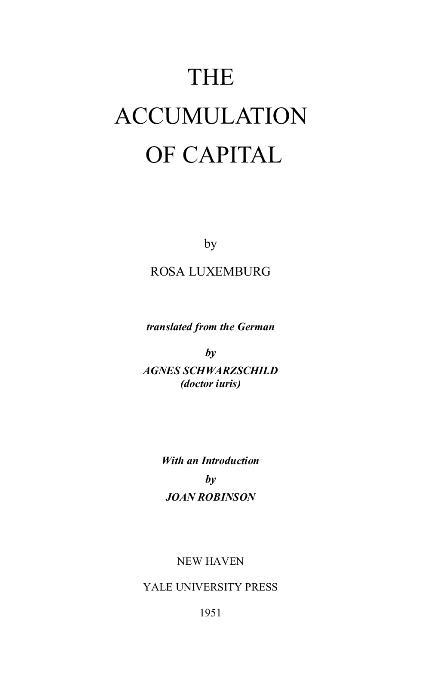




The book opens by examining the fundamental problem of reproducing total social capital, contrasting the analyses of Quesnay and Adam Smith. Luxemburg identifies a critical flaw in Smith's economic doctrine, which mistakenly resolved the total value of social production entirely into wages, profits, and rents, thereby making constant capital disappear from the aggregate social product. She demonstrates that value creation involves both the transfer of old value from means of production by concrete labour and the creation of new value by abstract labour.
Moving from simple to enlarged reproduction, Luxemburg analyzes the mechanisms of capital accumulation as outlined in Marx's economic schemes. She demonstrates that capitalist production requires not only the continuous renewal of constant and variable capital, but also an ever-increasing production of surplus value that must be capitalised. However, this process reveals a profound internal contradiction within closed capitalist economies.
Luxemburg argues that the surplus value to be capitalised cannot be realized within a closed capitalist system consisting solely of capitalists and workers, because workers can only buy consumer goods equivalent to their wages, while capitalists consume only a portion of their surplus value. The remaining surplus product cannot find internal buyers, since neither capitalists nor workers have an economic motive to consume or utilize the continually expanding mass of additional commodities.
To resolve this dilemma, Luxemburg introduces her central thesis, arguing that capitalism sustains its continuous accumulation by constantly expanding into non-capitalist environments. Through trade, conquest, and imperialism, capitalist economies absorb primitive and peasant modes of production, opening new markets and securing natural resources. This external expansion provides the necessary effective demand and prevents the system from falling into terminal economic stagnation.