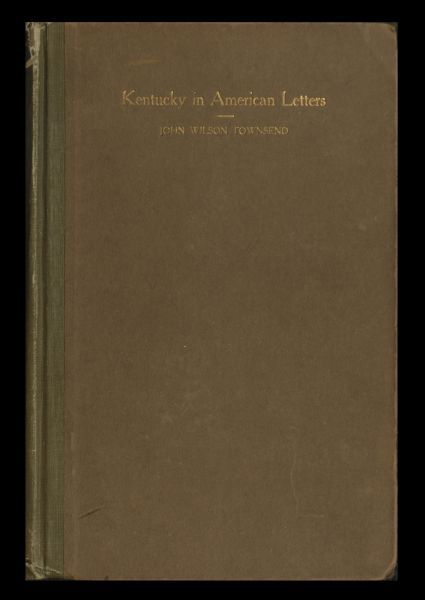



This two-volume historical work anthologizes the rich literary output of Kentucky from seventeen-eighty-four to nineteen-twelve, edited with biographical introductions and critical notes by John Wilson Townsend. The text presents a comprehensive survey of poets, novelists, and essayists who helped shape the distinct cultural identity of the Commonwealth.
The work is structured to showcase the evolution of Kentucky writing from early pioneer accounts to the sophisticated prose of the late nineteenth and early twentieth centuries. Townsend arranges the authors alphabetically, providing intimate biographical sketches that reveal the personal backgrounds and local influences behind their most celebrated works.
Among the figures highlighted are James Lane Allen, celebrated for his exquisite depictions of nature and local color, and Theodore O'Hara, whose immortal elegy remains a cornerstone of American poetry. The collection also captures the robust vernacular humor and frontier spirit that characterized much of the early regional literature.
Townsend examines the unique social and geographic factors that fostered such a fertile literary environment, contrasting the refined society of the Bluegrass region with the rugged isolation of the mountain communities. Through excerpts, poems, and critical evaluations, the author demonstrates how these diverse landscapes inspired a truly indigenous American literature.
The study addresses the critical problem of preserving regional authenticity in the face of growing national homogenization. Townsend argues passionately for the value of local traditions and the necessity of recording the oral histories and vernacular expressions of Kentucky pioneers before they vanished forever.
By gathering these scattered literary fragments into a cohesive whole, Townsend successfully establishes Kentucky as a distinct literary republic within the broader American nation. The work concludes by celebrating the flowering of a native-born artistic tradition that finally silenced the old reproach that the state had no literature.