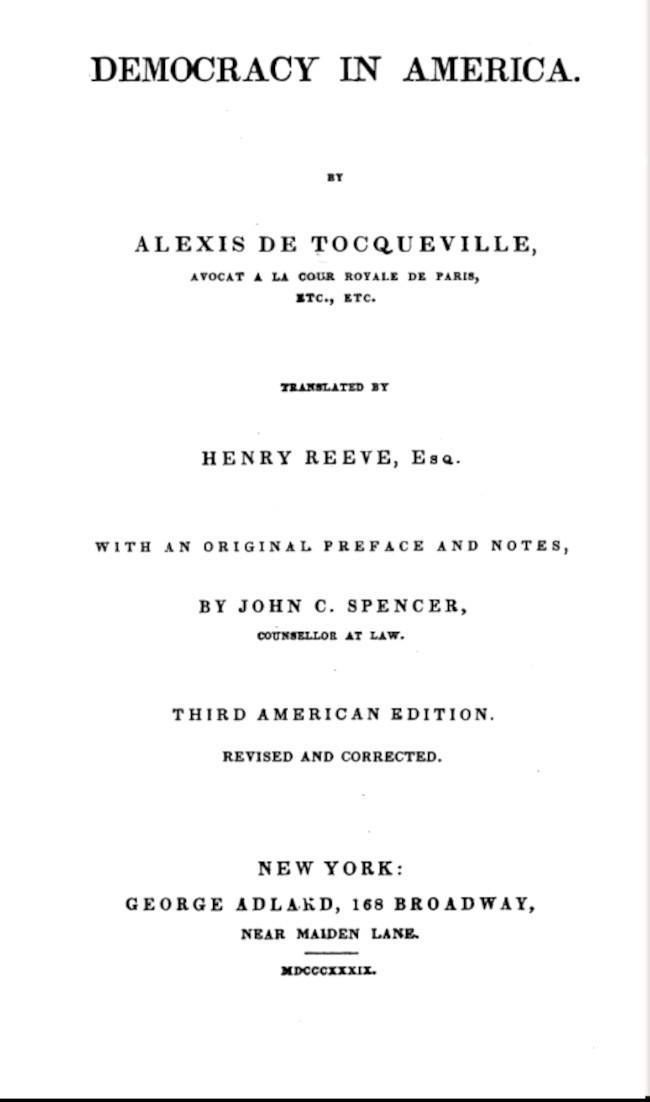



Alexis de Tocqueville investigates the deep social and political transformation of the United States, arguing that the fundamental driver of American society is the equality of conditions. Rather than viewing democracy as a mere political system, he examines it as a total social state that influences sentiments, habits, and legislation from the ground up.
Beginning with the geography of North America and the arrival of the early English colonists, the author traces how the absence of a feudal aristocracy allowed democratic principles to take root unhindered. The Pilgrims brought not only strict religious convictions but also radical notions of self-governance that manifested immediately in town meetings and social contracts.
The narrative explores the architecture of American local government, demonstrating how administrative decentralization—specifically the independence of the township and the county—fosters active public spirit and civic responsibility. By distributing power among numerous functionaries rather than concentrating it in a bureaucratic center, the system trains citizens in the art of self-rule.
The judicial power occupies a unique and powerful role in this framework. American judges possess the authority to declare laws unconstitutional, anchoring political oversight in private litigation and ordinary legal proceedings. This prevents the judiciary from acting as a partisan political body while still providing a robust check against legislative overreach.
Finally, Tocqueville analyzes the federal constitution, contrasting the sovereign rights reserved to individual states with the centralized authority granted to the Union over foreign relations and national commerce. He highlights the delicate balance between state independence and federal supremacy, noting the mechanisms designed to prevent the executive branch from degenerating into tyranny.
Throughout the work, the author maintains a detached, analytical perspective on the potential perils of majoritarian rule and the tyranny of the majority. The text concludes with reflections on the future of democratic societies, warning that while equality brings widespread material comfort, it also requires constant moral and political education to preserve true liberty.