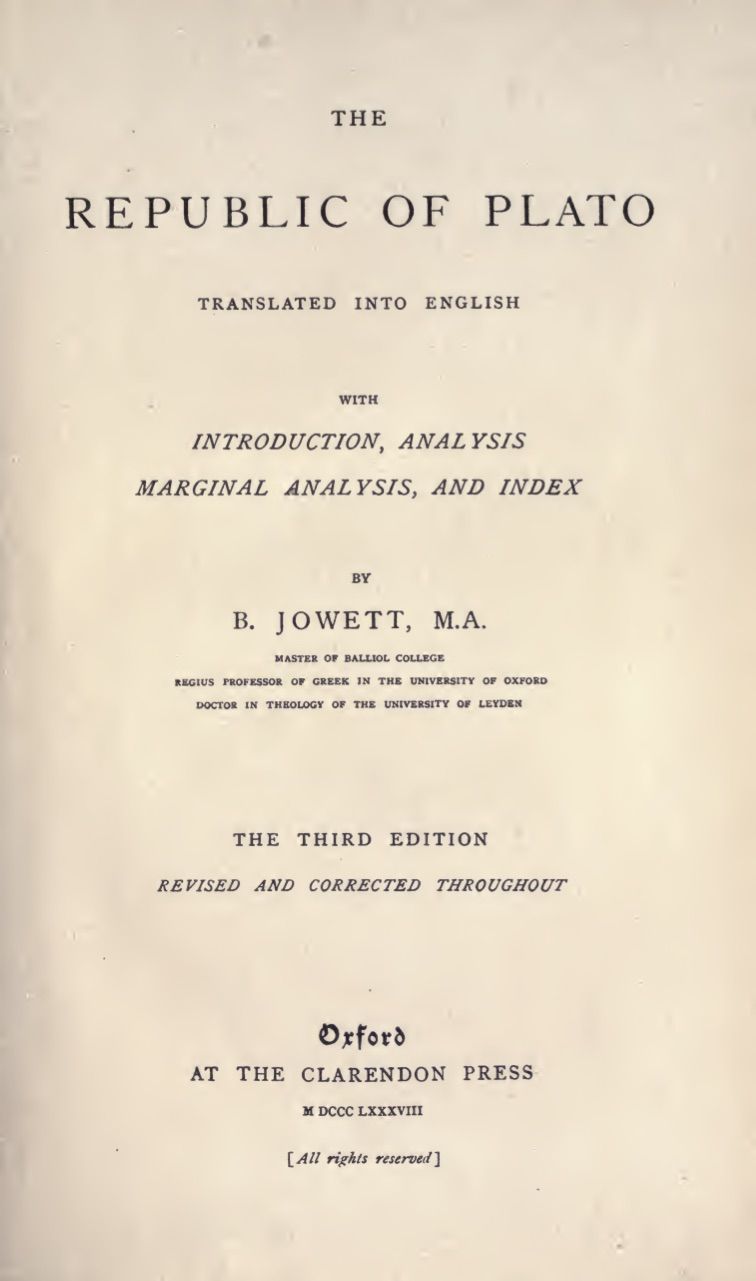

The dialogue begins with a discussion on the definition of justice among Socrates and various interlocutors, where conventional views are systematically dismantled. Glaucon and Adeimantus then challenge Socrates to prove that justice is desirable for its own sake, independent of its rewards and reputation, prompting the construction of an ideal city-state as a macrocosm of the human soul. This state is organized into three distinct classes—rulers, auxiliaries, and producers—corresponding to the rational, spirited, and appetitive parts of the soul. Education forms the cornerstone of this society, requiring rigorous censorship of poetry and balanced training in music and gymnastics to shape virtuous citizens.
The pinnacle of the state is reached through the rule of philosophers, who alone possess true knowledge of the immutable forms, culminating in the supreme idea of the good. Plato then examines the four perverted forms of government and corresponding human characters—timocracy, oligarchy, democracy, and tyranny—demonstrating how each stage represents a further moral decline from the ideal. The work concludes with a rigorous defense of justice, arguing that the just soul enjoys inner harmony and true happiness, whereas the tyrant suffers from internal slavery and torment. Finally, the dialogue addresses the age-old quarrel between poetry and philosophy, ultimately banishing mimetic art, and closes with the myth of Er, which reveals the immortality of the soul and the eternal rewards awaiting the just in the afterlife.