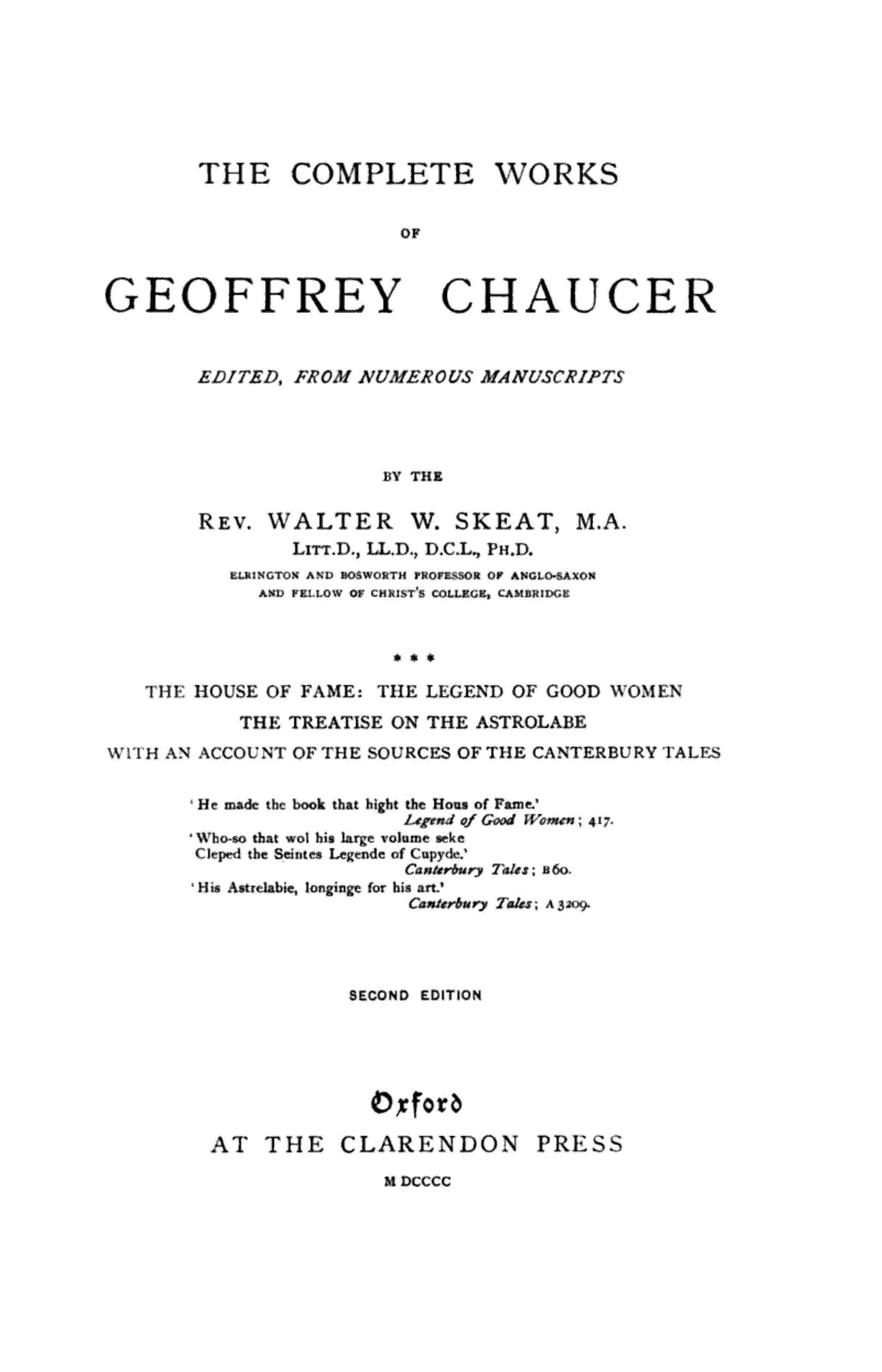
The volume opens with a thorough editorial introduction to The House of Fame, exploring its heavy reliance on Dante's Divine Comedy, Ovid's Metamorphoses, and Virgil's Aeneid. Skeat details the poem's composition around thirteen hundred and eighty-three, its four-accent rhyming metre of French origin, and its surviving manuscript sources, noting the emendations required to restore the text. The poem itself relates a dream-vision wherein the narrator visits a glass temple dedicated to Venus, reads the story of Aeneas inscribed upon a brass tablet, and is carried aloft by a golden eagle to the realm of sound and rumor.
The second major section covers The Legend of Good Women, assigned to the year thirteen hundred and eighty-five. Skeat analyzes its two prologues—the earlier A-text preserved uniquely in the Cambridge manuscript and the later B-text—highlighting how Chaucer sought the patronage of Queen Anne to secure relief from his demanding customs duties. The introduction traces the literary sources of the individual legends, including Boccaccio's De Claris Mulieribus and Ovid's Heroides, while explaining how the poet selected historical and mythical women renowned for their fidelity in love. The legends themselves recount the tragic fates of figures such as Cleopatra, Thisbe, Dido, and Lucretia.
The third major text is The Treatise on the Astrolabe, addressed to Chaucer's ten-year-old son Lewis. Skeat describes twenty-two surviving manuscripts of this practical guide, dividing them into authoritative textual classes based on the correct order of the second part's conclusions and the presence of diagrams. The editor discusses the Arabic and Sanskrit origins of the instrument, its adaptation in Latin treatises by Messahala, and the precise mechanical functions of the Rete, rule, and plates. Chaucer's text provides a simplified, vernacular manual for calculating hours, altitudes, and planetary motions, demonstrating the practical scientific education of the period.
The final section investigates the literary lineage of The Canterbury Tales. Skeat examines the complex interrelationship between Chaucer's narrative framework and John Gower's Confessio Amantis, particularly their mutual debts to classical and medieval authorities. The volume concludes with critical notes, variant readings, and historical commentary that clarify the linguistic nuances and textual corruptions of the manuscripts. Through these varied works, the collection maps the breadth of Chaucer's intellectual ambitions from poetic fantasy to empirical science.