
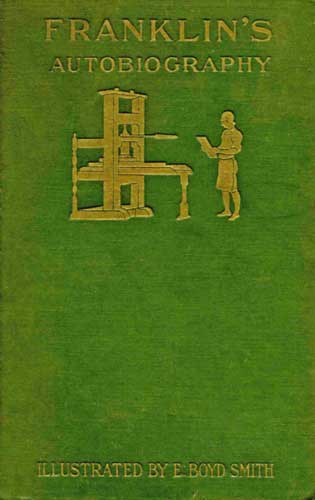




Benjamin Franklin begins his life story as a personal letter to his son, detailing his ancestry in Northamptonshire and his early upbringing in Boston as the son of a tallow-chandler. Deprived of a formal grammar school education due to family financial constraints, young Franklin cultivated a voracious appetite for reading and self-improvement. His path soon turned toward the printing trade, leading to an apprenticeship under his older brother James at the New England Courant. Restless under strict discipline, Franklin broke his indentures and fled secretly to New York before eventually settling in Philadelphia with very little money and characteristic resourcefulness.
In Philadelphia, Franklin found work as a printer and quickly gained the attention of colonial governors through his sharp intellect and ambition. After a brief and disillusioning sojourn in London working in famous printing houses, he returned to Philadelphia to establish his own printing business. Through relentless industry, strategic frugality, and the publication of Poor Richard's Almanac, he achieved financial independence and commercial success. His printing shop grew into a thriving enterprise, allowing him to step back from manual labor and dedicate his time to public service and intellectual pursuits.
Alongside his business ventures, Franklin became a central figure in the civic and intellectual life of Philadelphia. He founded the Junto, a mutual improvement society that served as the incubator for numerous public projects, including the first subscription library, the American Philosophical Society, the Union Fire Company, and the Pennsylvania Hospital. His scientific experiments, particularly his pioneering work with electricity and the invention of the lightning rod and the open stove, brought him worldwide renown and honorary academic degrees from leading universities.
As tensions mounted between the colonies and the French, Franklin turned his considerable organizational talents toward provincial defense. He successfully rallied the citizens of Pennsylvania to form a voluntary militia and organized transport for General Braddock's ill-fated military expedition. His political acumen culminated in the drafting of the Albany Plan of Union in seventeen hundred fifty-four, an early and visionary attempt to unite the colonies under a single government for mutual protection and shared administrative purposes.
Later portions of the memoir outline Franklin's ambitious and systematic project for moral perfection, centered around thirteen foundational virtues such as temperance, order, and sincerity. He devised a rigorous daily ledger system to track his moral progress, acknowledging that while absolute perfection proved unattainable, the continuous endeavor made him a better and happier man. The narrative blends personal anecdote with practical philosophy, illustrating how discipline, public spirit, and intellectual curiosity can elevate an individual from obscurity to lasting usefulness.

![Cover of the audiobook “Memoirs of Benjamin Franklin; Written by Himself. [Vol. 2 of 2]”](/media/books/memoirs-of-benjamin-franklin-written-by-himself-vol-2-of-2/cover.jpg)





![Cover of the audiobook “Minute Mysteries [Detectograms]”](/media/books/minute-mysteries-detectograms/cover.jpg)
