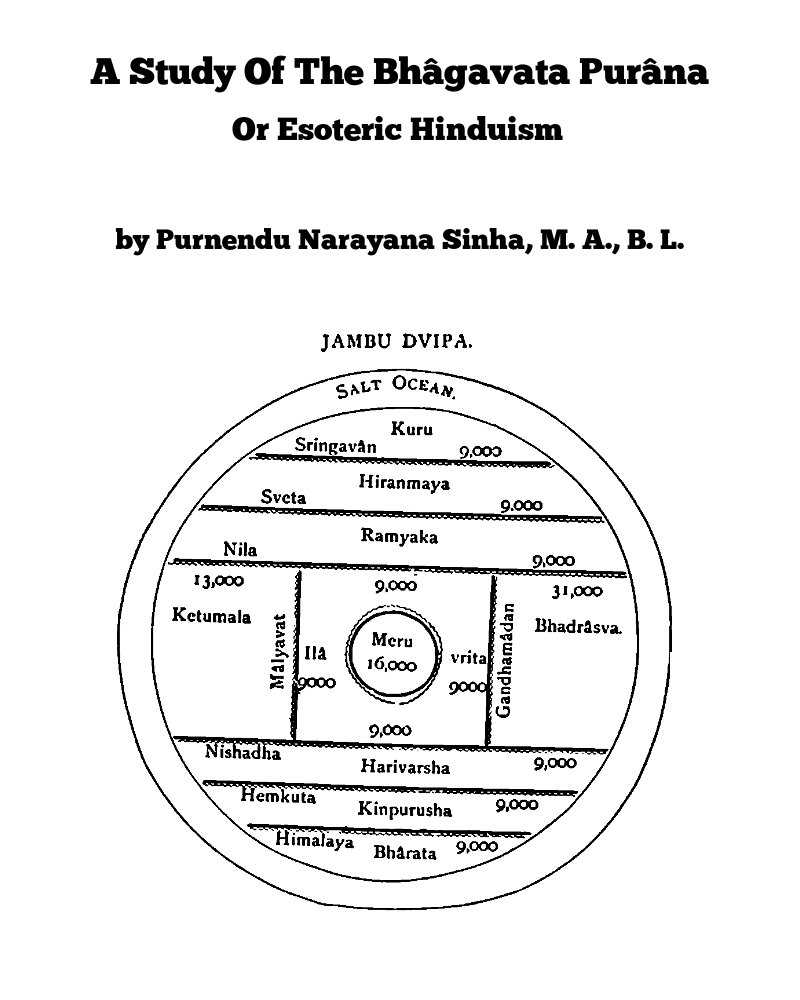





The work opens with an exposition on the nature of the Bhagavata Purana, emphasizing its authority as an essential spiritual guide for understanding the evolution of the cosmos and the human soul. The text details the primary creation of the universe through the disturbance of the Gunas, the role of Kala as time and the power of Purusha, and the subsequent formation of the Mahat, Ahankara, and the material elements. It outlines the geography of the universe, including the seven Dvipas, the central Meru, and the planetary spheres, while explaining the spiritual significance of the Nabhi Varsha as the primary field of human karma. Through extensive dialogues between teachers such as Maitreya, Kapila, and Narada, the text retells ancient histories, geneaological tables, and metaphysical principles.
Particular emphasis is placed on the science of Bhakti, detailing how unselfish action, meditation, and pure devotion lead the soul beyond the material planes. The narrative explores the dualities of existence through the conflicts of the Suras and Asuras, illustrating how spiritual evolution requires transcending material attachments and individual ego. The ultimate destination for the soul is shown to be the supreme abode of Vishnu, achieved by dissolving illusions and anchoring the mind in constant, undivided remembrance of the Divine.