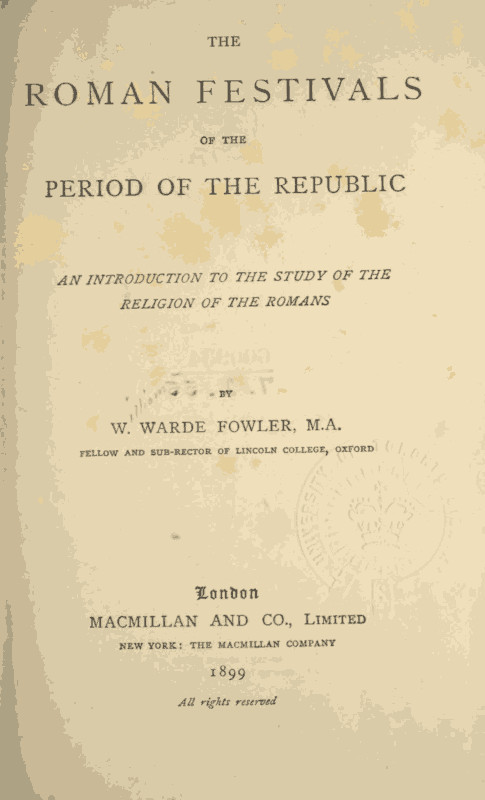






The author undertakes a comprehensive study of the Roman religious calendar as preserved in fragments of the ancient Fasti, following the calendar month by month through the Republican era. He establishes that the earliest Roman year began with March, a month dominated by the cult of Mars, viewed not merely as a god of war, but as an ancient agricultural power who quickened the earth, protected crops, and guarded the freshly enrolled host through ritual lustrations and the dance of the Salii.
The progression of the spring months—April, May, and June—is analyzed through the lens of agricultural anxiety and renewal. Festivals such as the Fordicidia, Parilia, Robigalia, and the Ambarvalia reveal a society deeply concerned with the germination of seeds, the protection of flocks from blight and predators, and the ritual purification of fields and storehouses. The author emphasizes that these early rites were practical, localized measures aimed at averting unseen dangers and securing the necessary conditions for survival.
A significant portion of the work is devoted to the cults of female and chthonic deities, including Vesta, Ceres, the Bona Dea, and Mater Matuta, whose worship reflected the central role of the household fire, grain storage, and maternal protection. The elaborate rituals performed by the Vestal Virgins, the opening and cleaning of the sacred storehouses, and the casting of rush puppets into the Tiber during the Argean ceremonies are examined as essential acts of ritual cleansing and sympathetic magic designed to ensure rain, growth, and divine favor.
Throughout the study, the author distinguishes between the genuine, austere substratum of native Italian religion and the later accretions of Greek and Oriental mythology that transformed Roman worship during the Republic. By anchoring his analysis firmly in the surviving epigraphical evidence of the calendar rather than late aetiological legends, he reconstructs the outline of the religious year as it was experienced by the early Roman farmer and citizen before the fall of the Republic initiated a new era of imperial cults and foreign superstitions.