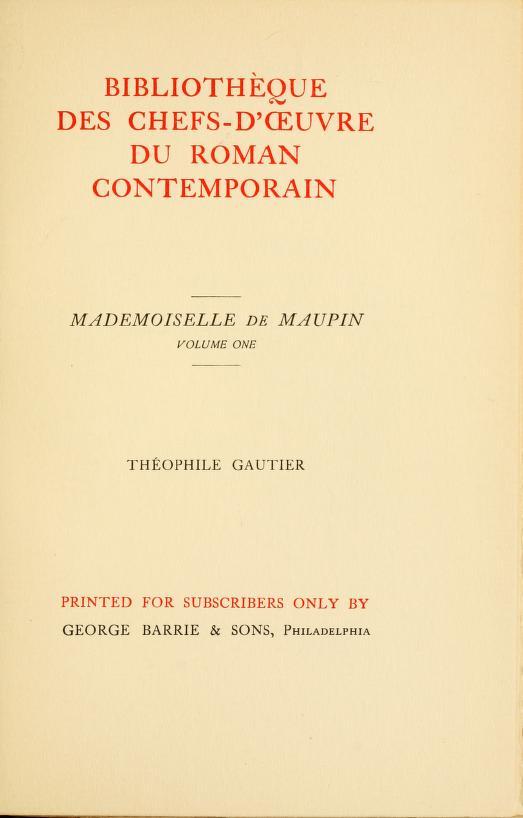




Mademoiselle de Maupin by Théophile Gautier opens with a lengthy and polemical preface that serves as a manifesto for art for art's sake. Gautier fiercely attacks the utilitarian critics and moralists of his era who demand that literature serve a didactic or social purpose. He argues that true art is inherently useless in the material sense, contending that beauty and pleasure are the only valid aims of human existence.
The narrative proper centers upon the young and introspective d'Albert, who suffers from a deep spiritual malady. D'Albert is tormented by an idealized vision of love and feminine beauty, a chimera constructed from memories of classical art, literature, and his own fervent imagination. Despite having a comfortable life and access to ordinary pleasures, he finds himself profoundly alienated from the prosaic world around him.
D'Albert seeks a mistress who can embody his exacting aesthetic standards, but every real woman he encounters falls short of his impossible internal pattern. He engages in a liaison with Rosette, a clever and worldly woman who tries to anchor him to reality. Although Rosette loves him deeply and accommodates his eccentric whims, d'Albert remains emotionally detached, treating her as a mere instrument for physical release while his soul wanders in search of his phantom ideal.
The arrival of a mysterious young cavalier named Théodore introduces a new psychological dynamic to the household. Théodore possesses a dual beauty that confounds ordinary categorizations of gender, captivating both d'Albert and Rosette. Through complex interactions and intellectual discourse, Théodore challenges conventional notions of identity and desire.
The plot develops as a series of philosophical explorations into the nature of love, art, and human consciousness. D'Albert struggles constantly against the limits of his own individuality, unable to fuse his soul with another or to find a genuine connection in a world governed by hypocrisy and convention. He realizes that the ideal he pursues does not exist in tangible form.
The novel gradually exposes the tragedy of the aesthetic temperament, which rejects the mundane compromises necessary for ordinary happiness. D'Albert remains trapped within the prison of his own intellect, unable to find rest either in the crude realities of physical existence or in the ethereal realms of his imagination.
The narrative concludes without a conventional resolution, leaving the protagonist suspended in his eternal quest. Gautier suggests that the pursuit of absolute beauty is a relentless burden that separates the artist from common humanity, offering no final peace but only a deeper awareness of the unbridgeable chasm between the dream and the reality.