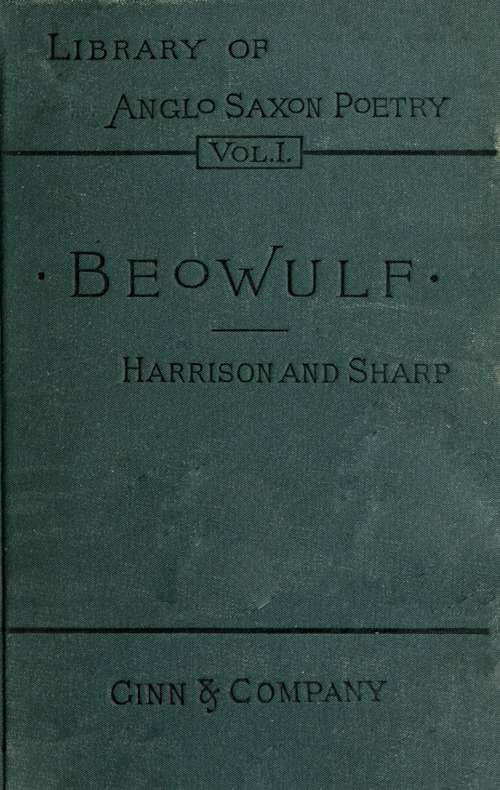


The epic opens with the lineage of the Danish royal house, tracing the line of Scyld Sceafing down to King Hrothgar. In the height of his power, Hrothgar builds the magnificent mead-hall Heorot, which for twelve years is plagued by the monstrous fiend Grendel, a descendant of Cain. Hearing of these terrible calamities, Beowulf, a nephew and thane of Hygelac, king of the Geats, sails across the sea with fourteen chosen warriors to offer his assistance. Upon their arrival on the Danish coast, they are cautiously welcomed by the coast-guard and subsequently received with great honor by Hrothgar in Heorot.
During the celebratory banquet, the envious courtier Hunferth taunts Beowulf about a youthful swimming match with Breca, prompting the hero to recount the true, arduous story of the contest and silence his challenger. As night falls, Hrothgar leaves the hall in Beowulf's charge. Grendel breaks in, devours one of the Geatish warriors, but is attacked by Beowulf in a fierce hand-to-hand struggle.
Beowulf tears the monster's arm completely from its socket, forcing the mortally wounded creature to flee back to its swampy lair. The Danes and Geats rejoice, showering Beowulf with splendid gifts and celebrating late into the night. However, the following night, Grendel's mother comes to avenge her son, carrying off Hrothgar's trusted councillor, Æschere. Beowulf and his men track the water-demon to her grim lair at the bottom of a desolate, haunted lake.
Plunging into the dark waters, Beowulf overcomes the monstrous mother in a desperate underwater battle, vanquishes her with an ancient giant-forged sword, and brings back the head of Grendel along with the ornate hilt. Laden with honors and rich treasures, Beowulf sails back to his homeland and recounts his extraordinary adventures to King Hygelac. The second half of the poem shifts fifty years forward.
Following the deaths of Hygelac and his son, Beowulf has ascended to the throne and ruled his people prosperously for half a century. Peace is shattered when a fire-breathing dragon, awakened by a runaway slave who stole a golden cup from its ancient hoard, begins to lay waste to the Geatish countryside with fire and destruction. Beowulf, now aged but still resolute, sets out with twelve men to seek the dragon's lair, haunted by a presentiment of his approaching end. He advances alone to face the fire-drake, but his sword shatters against the monster's scales, leaving him in grave peril.
All of his companions flee in cowardice, save for his loyal kinsman Wiglaf, who rushes to his aid. Together, Wiglaf and Beowulf succeed in slaying the dragon, but not before Beowulf sustains a fatal wound. Before he dies, the dying hero asks Wiglaf to bring out the golden treasures from the cavern so he can view them one last time. Beowulf passes away, leaving Wiglaf to bitter reproaches for the deserters and prophesying dark days of war and ruin for the Geats. The poem concludes with a solemn dirge and the construction of a magnificent funeral pyre and memorial mound on a promontory overlooking the sea.