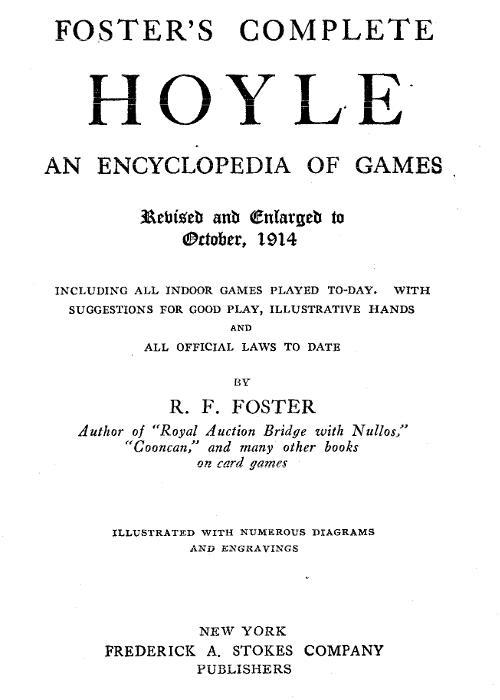




The work opens with an introduction to the evolution of indoor pastimes, tracing the historical development of games from their early origins to standardized modern codes. The author explains that many local variations arise because rules are transmitted orally rather than studied from authoritative sources, leading to inconsistent interpretations.
The text details the Whist family, identifying it as the root of modern trick-taking games. It outlines the history of whist from its ancestor ruff and honours, through the foundational principles laid down at the Crown Coffee House, up to the emergence of bridge and auction bridge. Detailed chapters cover scoring, leads, third-hand play, finessing, and the eleven rule.
Subsequent sections examine alternative card games including pinochle, euchre, piquet, cribbage, poker, baccarat, and solitaire. Each game is broken down by apparatus, player requirements, and the step-by-step course of play, accompanied by definitions of technical terms printed in boldface type for easy reference.
The volume addresses table and dice games with equal thoroughness, covering chess openings and endings, checker positions, billiards laws, backgammon throws, and craps probabilities. The author explains the mathematical laws of chance, detailing concurrent events, dice probabilities, and the mechanics of martingales.
Throughout the pages, the text emphasizes equity, common sense, and historical consistency in settling disputed points. Rather than relying on isolated personal opinions, the rules are compared across international sources to preserve the true spirit of each pastime for players and experts alike.