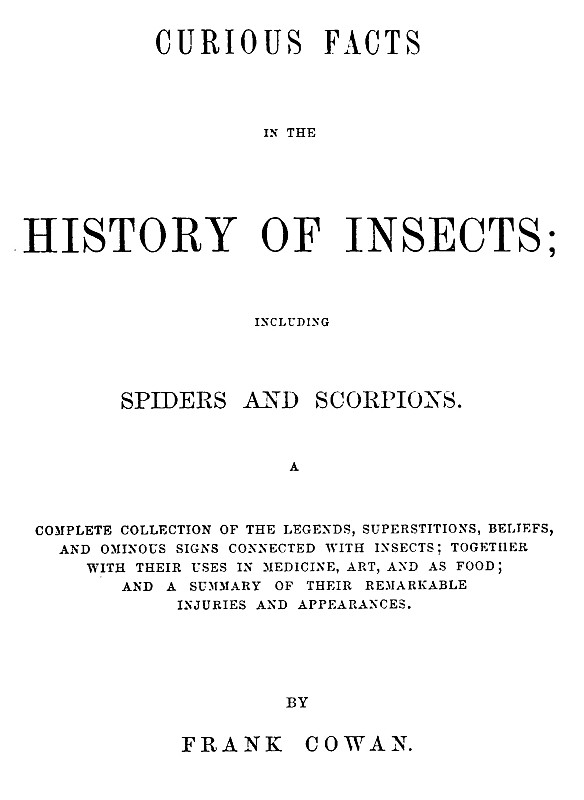


Frank Cowan approaches the science of entomology through an unusual lens, gathering historical accounts, superstitions, and cultural practices associated with insects from ancient chronicles, chronicles of travel, and classical literature. Rather than focusing solely on anatomy and classification, the author examines how different civilizations regarded these creatures, tracing their roles in medicine, art, and even human diet. The text methodically explores distinct orders of insects, beginning with beetles, and compiles centuries of human interaction with the natural world.
Throughout the pages, the text details how various cultures attributed supernatural or medicinal properties to common bugs. For instance, the ladybird has long been regarded across European nations as a harbinger of fine weather, an omen of harvests, and an indicator of romance, while certain beetles were used in traditional remedies for maladies ranging from toothache to colic. The narrative unfolds through meticulous historical citations, quoting writers from Pliny to contemporary nineteenth-century travelers who observed indigenous practices across Africa, Asia, and the Americas.
Particular attention is given to the sacred scarab of ancient Egypt, exploring its symbolic ties to the sun, the moon, and creation, alongside its frequent appearance in hieroglyphics, jewelry, and funereal rites. The author compiles extensive evidence of how Egyptians, Greeks, and Romans integrated insects into their religious and daily lives, often viewing them as embodiments of divine forces or using them in amulets designed to ward off evil.
Moving beyond mythology, the volume documents the devastating impact of migratory pests, such as locust swarms, detailing historical famines and the massive military-style efforts employed by various nations to curb their advance. Conversely, the text highlights regions where insects serve as a vital source of sustenance, noting the preparation and consumption of grubs, ants, and locusts by indigenous populations in Africa, Australia, and the Americas.
Ultimately, the work serves as a vast repository of human folklore regarding the insect world, illustrating how fear, utility, and imagination shaped our ancestors' perceptions of the smallest creatures. By preserving these diverse historical records, the author demonstrates the profound influence insects have exerted on human history, mythology, and survival.