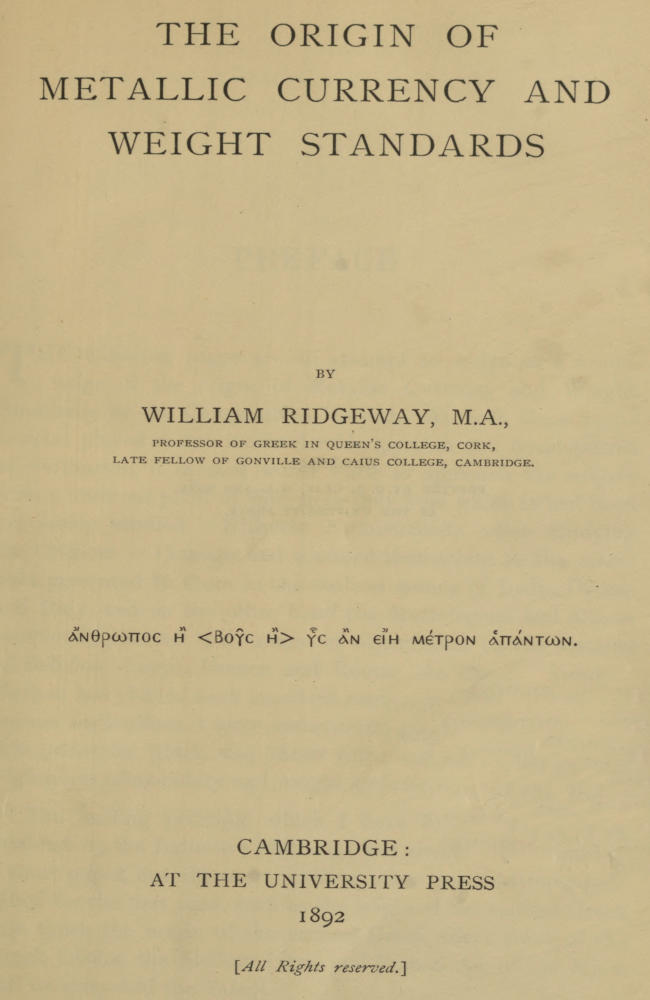



William Ridgeway investigates the primitive foundations of metallic currency and weight standards by employing the comparative method across ancient and modern societies. The text challenges the prevailing scholarly belief that ancient metrology derived purely from the scientific calculations of Babylon or Egypt. Instead, it traces the evolution of money from early barter systems where cattle, skins, and shells served as universal units of value. The argument demonstrates that the ox was the primary unit of value across Europe, Asia, and North Africa long before the introduction of coined money.
As gold became known through widespread alluvial deposits and ancient trade routes, it was weighed against this traditional standard. The early weight units of the Mediterranean and Asian worlds, such as the Homeric talent, ultimately represented the conventional value of an ox in gold. The work traces the distribution of gold-fields from the Ural-Altai region to Spain and examines early trade routes connecting diverse civilizations. Through detailed induction, the study reveals how metallic currency and weight standards grew organically out of primitive economic needs rather than arbitrary state legislation.