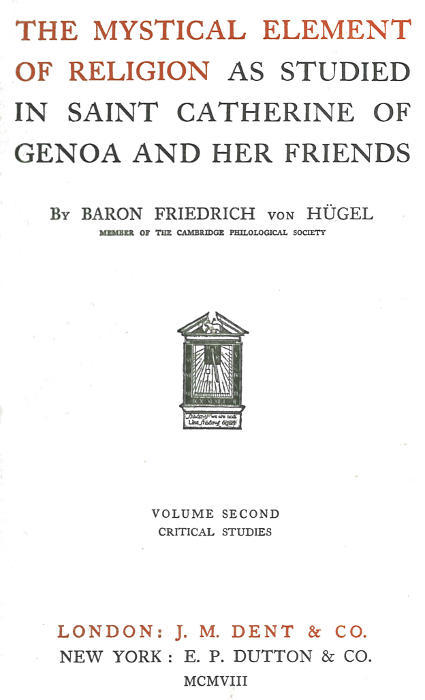



Friedrich von Hügel examines the life and teachings of Saint Catherine of Genoa, focusing on her mystical theology and the profound spiritual evolution she experienced. The text investigates her later years, characterized by extraordinary psycho-physical states, and explores how her physical infirmities mirrored an intense interior spiritual transformation. Hügel analyzes the driving forces of her spiritual life, contrasting her deep mystical apprehensions with contemporary psychological understanding, while maintaining a balanced view of her mystical experiences without reducing them to mere pathology. The core of Catherine's teaching centers on pure love, the nature of purgation, and the soul's ultimate union with God.
She perceived Purgatory not merely as a place of retributive punishment, but as an internal state where the soul is purified of its self-love and earthly attachments by the overwhelming fire of divine love. This divine love acts as a purifying agent, consuming every vestige of egoism and selfishness until the soul achieves complete conformity with the divine will. The book further traces the literary and historical sources that influenced Catherine's conceptions, including the Pauline and Joannine writings, the works of pseudo-Dionysius, and the mystical poetry of Jacopone da Todi.
Hügel demonstrates how these diverse traditions converged in her thought, shaping her unique understanding of divine immanence, the human personality, and the relationship between the soul and God. Through careful philological and historical analysis, the author constructs a comprehensive portrait of a mystic whose spiritual depth continues to challenge and illuminate theological philosophy. The work concludes with a synthetic summing up of the fundamental forces of the soul and the corresponding elements of religion, emphasizing the necessity and the inherent mutual tension between asceticism, social religion, and the scientific habit of mind in the pursuit of ultimate religious truth.