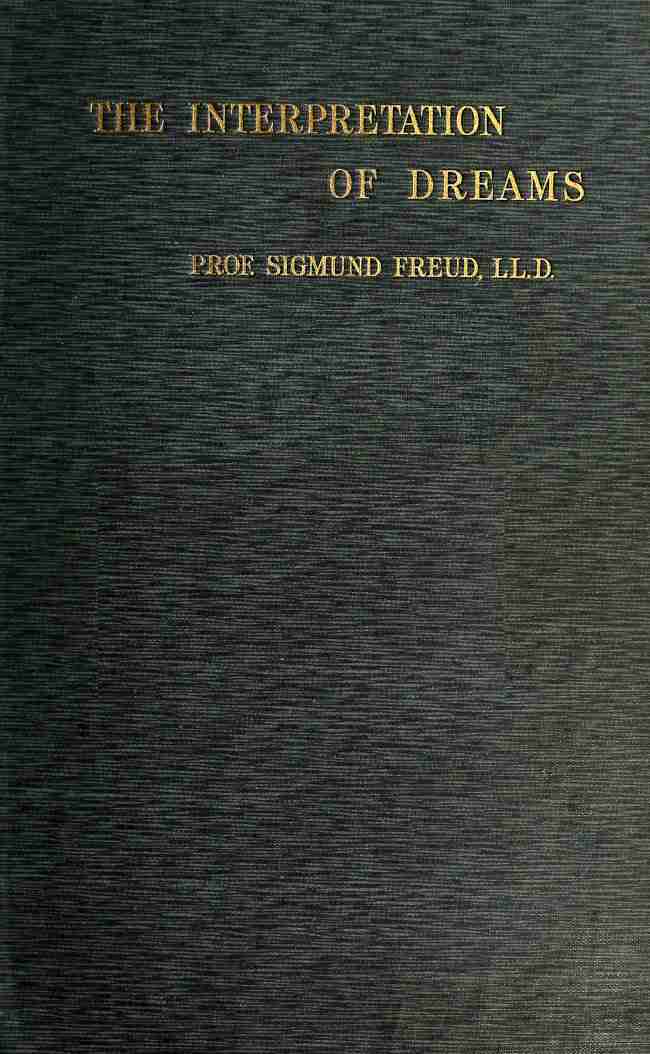






The Interpretation of Dreams introduces the revolutionary proposition that dreams are not meaningless physiological discharges, but coherent psychological formations that fulfill repressed wishes. Freud begins by reviewing historical and scientific literature on dreaming, demonstrating that previous theories fail to account for the true nature of dream content. He then introduces his primary methodological breakthrough, using self-analysis to show how manifest dream images mask latent thoughts through the operations of condensation, displacement, and symbolization.
A central thesis of the work is the distinction between the manifest content—what the dreamer remembers—and the latent thoughts discovered through psychoanalytic interpretation. Freud argues that dream distortion is the result of a mental censor that guards consciousness against unacceptable or painful impulses. By examining everyday examples, children's dreams, and clinical cases, he illustrates how even distressing anxiety dreams function as disguised wish-fulfillments when properly understood.
The work also explores the peculiar characteristics of dream memory, showing how the mind draws upon indifferent, recent impressions from the dream-day while simultaneously recovering long-forgotten elements from early childhood. Freud connects dream mechanisms to the formation of psychopathological symptoms, suggesting that studying dreams sheds light on both normal mental processes and the etiology of neuroses.
Ultimately, the volume establishes psychoanalytic technique as a rigorous tool for exploring the inner mind. By proving that dreams possess a discoverable meaning and a logical structure, Freud transforms the subjective experience of dreaming into a foundational pillar of modern psychological theory.