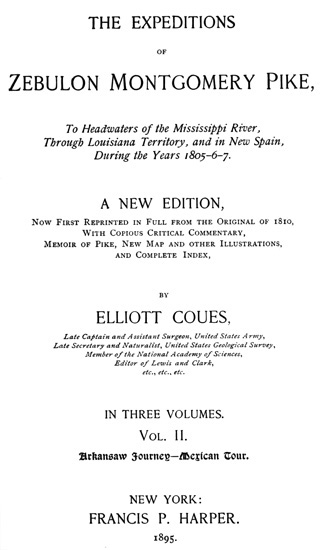






The second volume of Zebulon Montgomery Pike's official journals documents the most perilous phase of his government-sanctioned western exploration. After parting with Lieutenant Wilkinson, who descended the Arkansas River, Pike and his dwindling, poorly clothed party pushed westward into the freezing peaks of modern-day Colorado. Their stated goal was tracing the headwaters of the Red River, but harsh winter weather, deep snows, and near-starvation pushed the men to their physical limits. Pike vividly describes the immense herds of bison on the plains, the towering mountain that now bears his name, and the extreme hardships of marching without adequate winter gear or food.
Miscalculating their geography, the party crossed the Sangre de Cristo Mountains and descended into the San Luis Valley, firmly believing they had reached the Red River. In reality, they had crossed into Spanish territory along the upper Rio Grande. There, near the Conejos River, Pike constructed a fortified stockade to shelter his freezing men while they awaited relief or attempted to regroup.
Throughout these months, Pike maintained detailed astronomical observations and recorded extensive notes on the local geography, weather patterns, and his interactions with indigenous tribes, including encounters with a hostile band of Pawnee warriors. His scientific notes capture the stark realities of the American desert and the towering alpine environment.
The narrative culminates in February eighteen hundred and seven, when Spanish dragoons arrived at the stockade. Upon realizing he was on the Rio del Norte within New Spain, Pike lowered his American flag and submitted to an escort to Santa Fe. This volume bridges the gap between official exploration and international political friction, offering a primary-source perspective on the early nineteenth-century frontier.