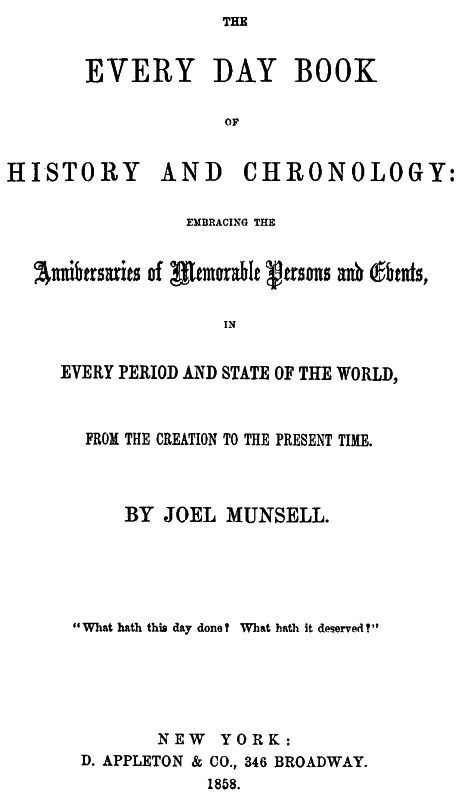

Joel Munsell presents a comprehensive chronological reference work designed to bring together the great historical events of each calendar day from antiquity to the mid-nineteenth century. The author gathers notices of eminent personages, battles, discoveries, and cultural milestones, organizing them strictly by date to provide an accessible historical archive for readers of every pursuit. Throughout the compilation, Munsell addresses the inherent difficulties of historical research, including discrepancies arising from calendar reforms such as the shift from the old Julian style to the Gregorian calendar adopted at different times across European and Protestant nations.
The volume covers an immense breadth of human history, detailing the reigns of Roman consuls, the martyrdom of early saints, the deeds of Swiss patriots, and the foundational voyages of maritime explorers. Special attention is given to the military engagements, political revolutions, and literary births that shaped nations, alongside eccentric anecdotes and records of extraordinary longevity. Munsell highlights the intricate complexities of reconciling conflicting dates found among disparate historical authorities, emphasizing the vigilant care required to maintain chronological accuracy.
Biographical sketches range from brief two-line notices of obscure figures to extensive accounts of world leaders, artists, scientists, and explorers whose discoveries transformed human knowledge. The work documents the foundation of ancient empires, the rise and fall of dynasties, and the progression of scientific inventions, from early astronomical observations to the establishment of modern postal and financial systems.
By uniting geography and chronology as the twin eyes of history, the author constructs an exhaustive repository of facts that illustrates the continuity of human experience across millennia. The narrative structure flows from January through December, capturing the daily pulse of civilization through centuries of triumphs, tragedies, and quiet innovations. The work concludes as an indispensable reference monument, preserving the fragile threads of chronology for posterity without offering direct closure to the unending march of time.