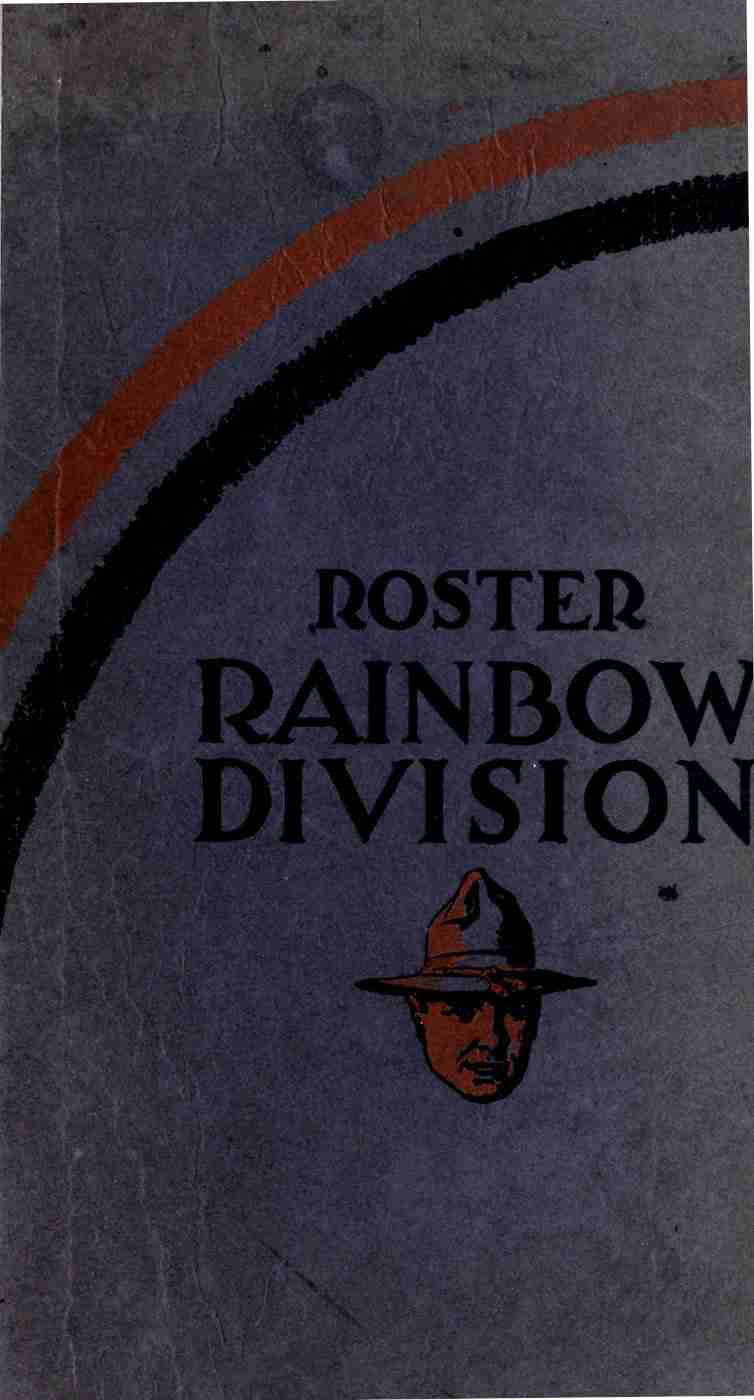



The book presents a comprehensive organizational directory of the United States Army Forty-Second Infantry Division, famously designated the Rainbow Division by Secretary of War Newton Baker. Representing twenty-six states from coast to coast, the division brought together National Guard units with proven combat experience from the Spanish-American War and the Mexican border skirmishes. Lieutenant Harold Stanley Johnson compiled the roster during the initial mobilization at Camp Mills on Long Island in October nineteen seventeen, aiming to foster cohesion and mutual acquaintance among the diverse state contingents prior to their deployment to the battlefields of Europe.
The volume details the command structure, staff officers, and complete personnel lists for division headquarters, headquarters troops, military police, field signal battalions, ammunition and supply trains, machine gun battalions, engineer regiments, and the associated ambulance companies and field hospitals. Key figures mentioned include Major-General William A. Mann commanding the division, Chief of Staff Colonel Douglass MacArthur, and Brigadier-General Charles P. Summerall commanding the sixty-seventh artillery brigade. The text methodically outlines the exact organizational units that made up the formation, ranging from the one hundred and sixty-fifth through the one hundred and sixty-eighth infantry regiments to the various field artillery regiments and trench mortar batteries.
Beyond mere administrative listing, the text reflects the immense logistical mobilization of an entire nation assembling volunteers and guardsmen into a unified fighting force. It captures the geographical breadth of the United States, listing soldiers from rural towns and major cities alike who were tasked with representing the country abroad. The pages serve as a permanent snapshot of the division before it entered combat, preserving the names, ranks, and home addresses of the men who formed America's vanguard in the First World War. The compilation concludes with the complete rosters of the artillery brigades, infantry regiments, and engineer units, providing an invaluable genealogical and historical resource for descendants and researchers studying the American Expeditionary Forces.


![Cover of the audiobook “Faust [part 1]. Translated Into English in the Original Metres”](/media/books/faust-part-1-translated-into-english-in-the-original-metres/cover.jpg)