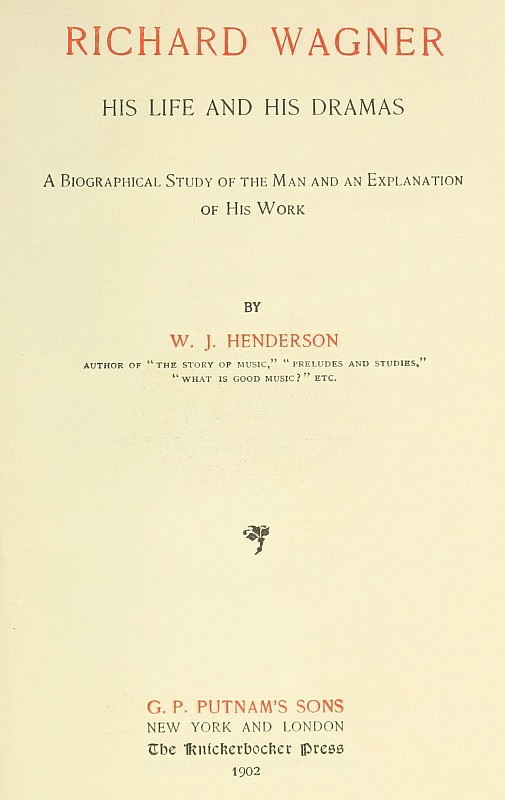


William James Henderson provides a comprehensive biographical and critical study of Richard Wagner, tracing his journey from an impoverished and struggling young conductor to the preeminent master of the lyric stage. The book opens with Wagner's birth in Leipzig, his early dabblings in poetry and tragedy, and his difficult apprenticeship in minor German opera houses. Henderson documents the composer's painful years of poverty in Paris, his flight from political unrest in Saxony, and his eventual salvation through the patronage of King Ludwig of Bavaria.
The author closely examines the composition of each major music drama, from the early conventional works like Rienzi to the mature revolutionary masterpieces. Henderson details the literary and mythological sources utilized by Wagner, showing how he abandoned historical realism in favor of universal legends. The evolution of the music-drama theory is traced through the creation of the Flying Dutchman, Tannhäuser, and Lohengrin, up to the monumental conception of the Ring cycle and Tristan und Isolde.
A significant portion of the book is devoted to explaining Wagner's artistic aims and his unique musical system. Henderson analyses the abandonment of conventional operatic forms in favour of continuous melody and the thematic use of leading motives. The narrative also covers the establishment of the Bayreuth Festival and the arduous physical and financial struggles required to bring the master's most ambitious visions to the stage.
The study concludes with a balanced assessment of Wagner's complex personality, acknowledging his extravagant tastes and intense egotism alongside his unwavering artistic dedication. Henderson paints a vivid portrait of a man who suffered deeply for his convictions yet ultimately revolutionized the landscape of classical music and theatrical art. The book gently hints at the master's final resting place at Wahnfried, leaving a legacy that forever transformed how the world perceives the music drama.