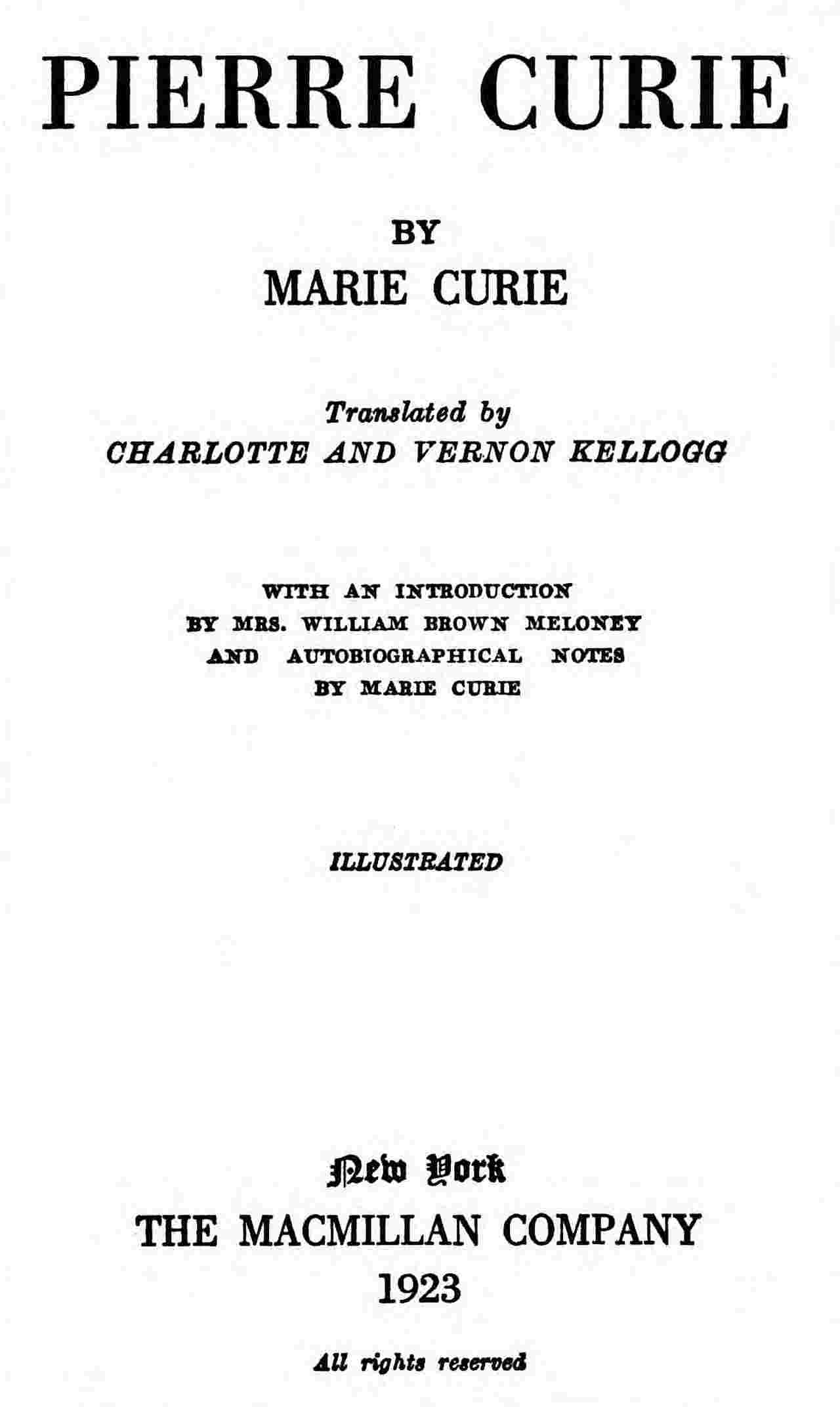


The book begins with Pierre Curie's childhood and early education under the guidance of his father, a physician of strong republican and humanitarian convictions. Marie Curie recounts Pierre's early scientific work, including his pioneering research with his brother Jacques on piezo-electricity and the formulation of the fundamental principle of symmetry.
The narrative details Pierre's long tenure as laboratory director at the School of Physics and Chemistry, where he carried out groundbreaking investigations on the magnetic properties of bodies at high temperatures, culminating in his doctoral thesis and the establishment of the Curie law.
A central turning point is the meeting of Pierre and Marie in Paris, their marriage based on a shared dream of an existence consecrated to science, and the subsequent birth of their daughters. The core of the book describes the grueling years of research in a drafty, inadequate shed, driven by the hypothesis that uranium ores contained an unknown, highly active substance.
The authors detail the painstaking chemical processing of tons of pitchblende residues that ultimately led to the historic isolation of polonium and radium. This monumental achievement revolutionized physics and chemistry, overthrowing the dogma of the absolute fixity of the atomic edifice through the discovery of radioactive transformations and the spontaneous discharge of heat.
Despite international acclaim, the awarding of the Davy medal, and the Nobel prize, Pierre Curie remained resolutely opposed to honorary distinctions and commercial exploitation, believing that scientific knowledge belongs to all people. The biography concludes with the tragic accident in nineteen hundred and six that cut short his brilliant career, followed by Marie Curie's reflections on the national sorrow and the urgent necessity of supporting scientific laboratories as the true temples of human progress.