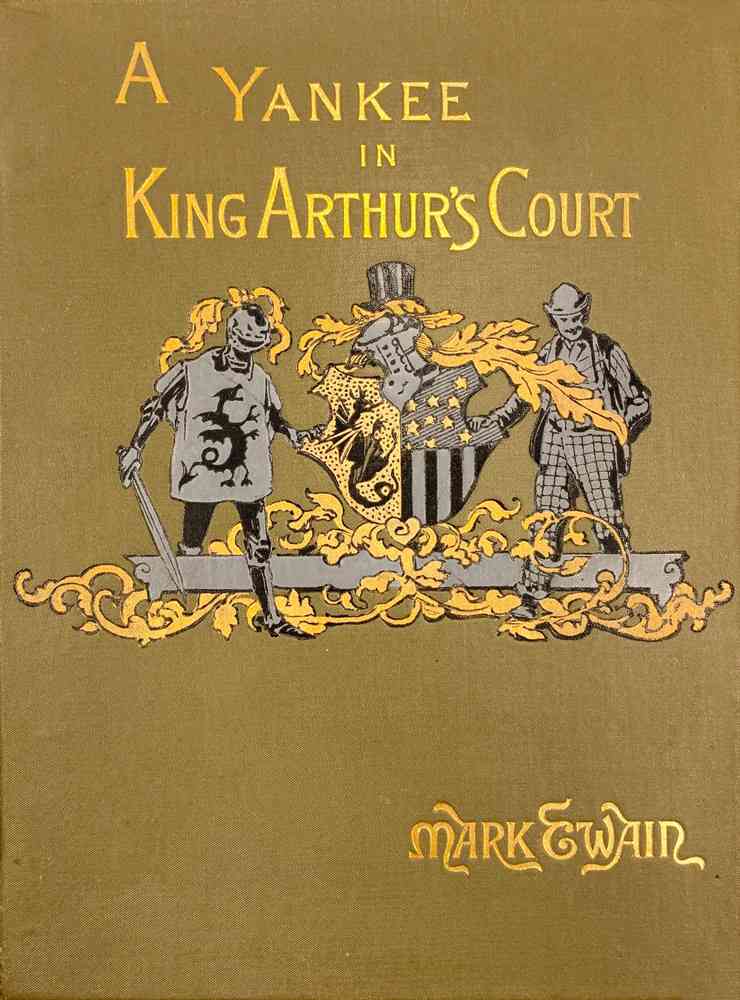
The narrative opens as a Connecticut man is knocked unconscious in an industrial accident and awakens in Arthurian Camelot among superstitious, simple-minded folk. Recognizing the immense advantage of his modern education by more than a millennium, he resolves to transform the primitive feudal society. After saving his life from a death sentence by accurately predicting a total solar eclipse, he establishes himself as the supreme power behind the throne, second only to the king.
Operating under the alias of The Boss, the protagonist secretly builds factories, schools, a patent office, and a telegraph network, all while striving to undermine the oppressive influence of the Roman Catholic Church and the cruel institution of knighthood. He strives to educate the populace and slowly introduce the concepts of democracy and individual liberty without sparking a premature violent uprising. To test his systems and understand the plight of the common folk, he disguises himself and travels the countryside.
Throughout his journey, he encounters the brutal realities of a stratified feudalism where serfs and freemen suffer under the merciless taxation and abuse of an unearned aristocracy. His mission is constantly threatened by ancient superstitions, the traditional habits of knight-errantry, and the bitter rivalry of Merlin, who views him as a professional threat. Despite these hurdles, he successfully asserts his dominance through theatrical demonstrations of modern science.
The text details his growing disillusionment with the romanticized myths of chivalry as he observes the squalor, cruelty, and intellectual stagnation of the era. He organizes a secret military academy and works tirelessly to lay the foundational infrastructure for a future industrial revolution. Through wit, pragmatic enterprise, and sheer audacity, he lays the groundwork for a sweeping political transformation that will eventually challenge the very roots of feudal power.
As the narrative progresses, the tension between his modern ideals and the deep-seated traditions of the sixth-century world reaches a critical threshold. The stage is set for a monumental conflict between the dawning light of reason and the entrenched darkness of mediaeval autocracy, hinting at the inevitable clash of civilizations to come.