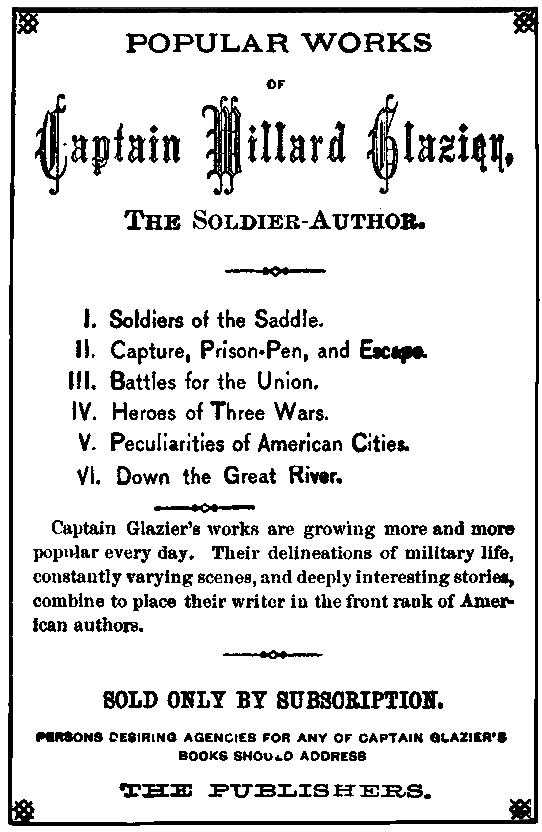





The narrative opens with the early life and education of Willard Glazier in northern New York, tracing his development from an ambitious schoolboy to a determined self-made youth. With the outbreak of the American Civil War, Glazier enlists in the Harris Light Cavalry, quickly rising through the ranks as he participates in major engagements including Brandy Station, Manassas, Aldie, and Gettysburg. The prose vividly captures the dust and confusion of cavalry charges, the loss of comrades, and the grim reality of battlefields strewn with the fallen.
The central portion of the book focuses on Glazier's capture during the cavalry skirmishes of October eighteen hundred and sixty-three. Plunged into the grim depths of Libby Prison in Richmond, he confronts the stark horrors of military confinement, characterized by starvation, disease, and psychological decay. The narrative details the daily existence of the captives, their ingenious yet frequently thwarted plots for escape, and the solidarity forged among men facing slow destruction.
From Libby Prison, the narrative follows the transfer of prisoners southward to Danville, Macon, and Savannah. Through these transitions, the text illuminates the contrasting temperaments of their captors, ranging from the brutal indifference of prison wardens to the surprising humanity of battle-hardened Confederate soldiers. The constant undercurrent of the narrative is the unquenchable desire for liberty, manifested in daring tunnels and desperate attempts to slip past the sentinels.
The closing chapters reflect upon the broader scope of the conflict, the immense human cost paid by both North and South, and the eventual restoration of the Union. Glazier's perspective broadens from personal survival to an appreciation of the historic scale of the struggle. The work concludes with the author's emergence from captivity, marking the end of a remarkable odyssey from the quiet school-rooms of New York to the blood-stained fields and dungeons of the Civil War.