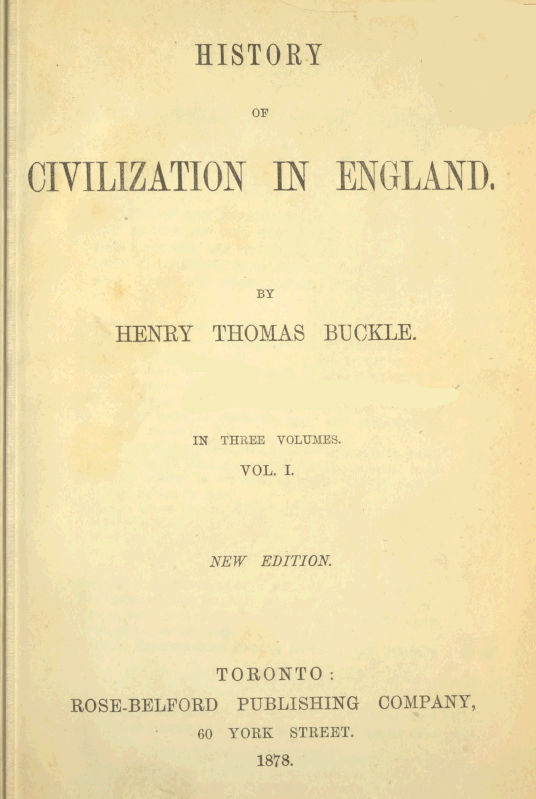






The work opens with the assertion that history has long languished as an empirical pursuit because historians have stubbornly refused to treat human actions as subject to fixed laws. By examining large-scale statistical data regarding crimes, suicides, and marriages, the author demonstrates that human behaviour exhibits an astonishing regularity. These actions, when viewed in the aggregate, are not the result of capricious free will, but are instead the predictable outcome of preceding circumstances and social conditions.
The inquiry then shifts to the physical agents that powerfully influence the human race, dividing them into climate, food, soil, and the general aspect of nature. These physical forces dictate the earliest steps of civilization by governing the accumulation and distribution of wealth. In regions where the soil is naturally fertile or the climate fosters specific crops, wealth accumulates rapidly, yet this very abundance often leads to an unequal distribution that depresses the labouring classes into permanent subjection. This pattern is traced across the ancient civilizations of India, Egypt, Mexico, and Peru, where cheap food stimulated rapid population growth and produced societies characterized by deep inequality and absolute despotism.
In contrast, European civilization developed under different physical conditions, where a more temperate climate required more active labour, thereby altering the reward for work and creating a more balanced distribution of wealth. This shift in the relationship between man and external nature fostered an intellectual environment where the reasoning faculties could gradually challenge the dominance of the imagination. In tropical regions, by contrast, the formidable aspects of nature—such as earthquakes, dangerous diseases, and sublime mountain ranges—terrified the human mind and encouraged an uncritical reliance on supernatural causes, which entrenched superstition and hindered scientific inquiry.
The final portions of the text apply these principles to literature, religion, and art, comparing the imaginative exuberance of Indian culture with the more grounded intellect of ancient Greece. Through rigorous comparative analysis, the author shows how human progress depends not upon the unearned bounty of nature, but upon the disciplined exercise of the human intellect against natural obstacles. The volume concludes by laying the groundwork for a comprehensive philosophy of history that unites the study of internal mental phenomena with the external physical world.