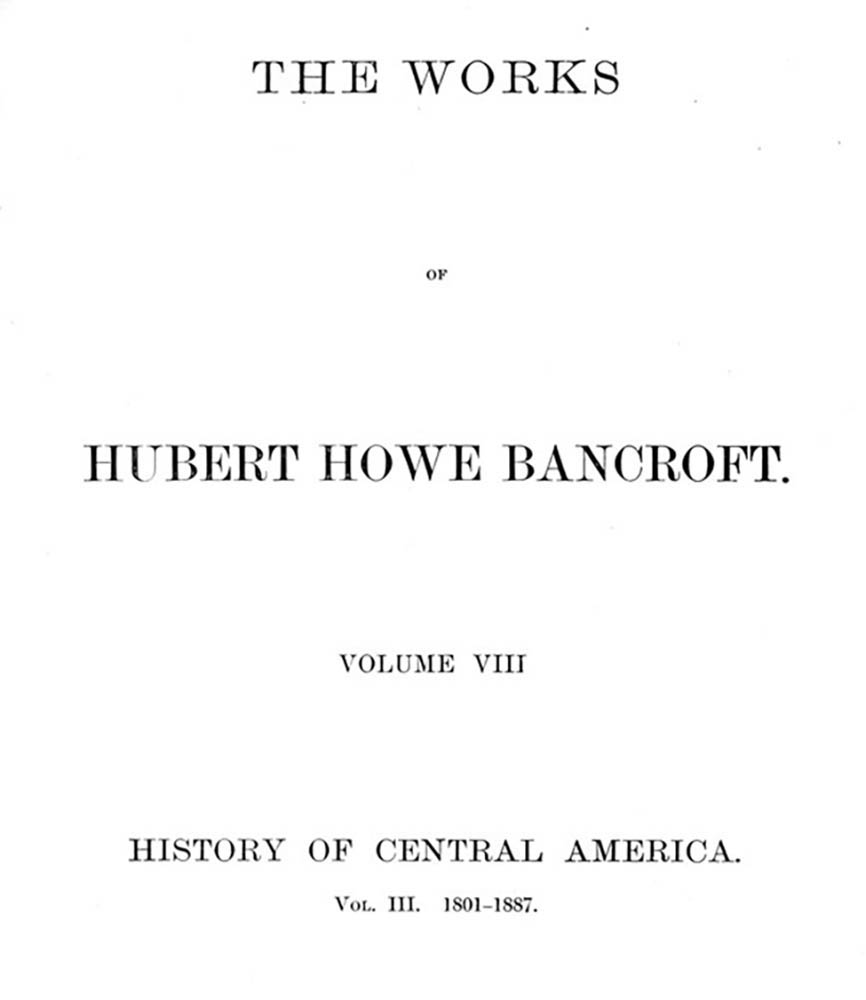





The third volume of Hubert Howe Bancroft's history of Central America covers the turbulent decades from eighteen hundred and one to eighteen eight-seven. The narrative opens with the final days of Spanish administration, marked by growing popular discontent, the impact of events in Spain, and the despotic rule of officials who attempted to stem the tide of revolutionary sentiment. As the grip of the mother country weakened, the provinces achieved independence, only to plunge immediately into complex political maneuvers and factional disputes that characterized the early nineteenth century.
A central focus of the work is the brief and unstable union with the Mexican empire under Iturbide, a period driven by conservative maneuvering and military pressure that ultimately alienated the republican factions. Following the collapse of the Mexican empire, the Central American provinces established a federal republic, embodying high liberal ideals but plagued by deep-seated regional rivalries, economic exhaustion, and intense partisan polarization between liberals and conservatives.
The narrative meticulously tracks the bloody civil conflicts that tore the federation apart. Figures such as Manuel José Arce and Francisco Morazan struggled against regional separatism and conservative reaction, fighting to preserve a unified nation against overwhelming odds. The rise of popular insurgencies, notably the indigenous revolts led by Rafael Carrera in Guatemala, accelerated the disintegration of the central government and paved the way for conservative dominance.
As the federal experiment collapsed, each state—Guatemala, Honduras, Salvador, Nicaragua, and Costa Rica—charted its own distinct path. The author details the internal politics, successive dictatorships, foreign interventions, and filibustering expeditions, such as William Walker's campaign in Nicaragua, that threatened regional sovereignty. These localized struggles gradually gave way to more stable, albeit often authoritarian, republican regimes across the isthmus.
The volume concludes by surveying the social, intellectual, and economic transformation of the region up to eighteen eighty-seven. It examines public education, the shifting role of the church, judicial reforms, agricultural progress, and early efforts at interoceanic communication, including the development of the Panama railway. Through meticulous documentation, the work captures the painful birth pangs of modern Central American nationhood, highlighting the resilience of societies repeatedly battered by civil war and foreign intrigue.